Quick answer
Dry Nov–Apr; monsoon May–Oct. Stay Long Beach (convenient), Ong Lang (quiet), An Thoi (islets). Day-trip An Thoi by boat; Hon Thom cable car ~15 min. Flights: HCMC 1h, Hanoi 2h. Ferries: Ha Tien 1.5–2h, Rach Gia 2.5–3h. 30‑day Phu Quoc visa waiver; e‑visa otherwise.
Why this guide
About this guide
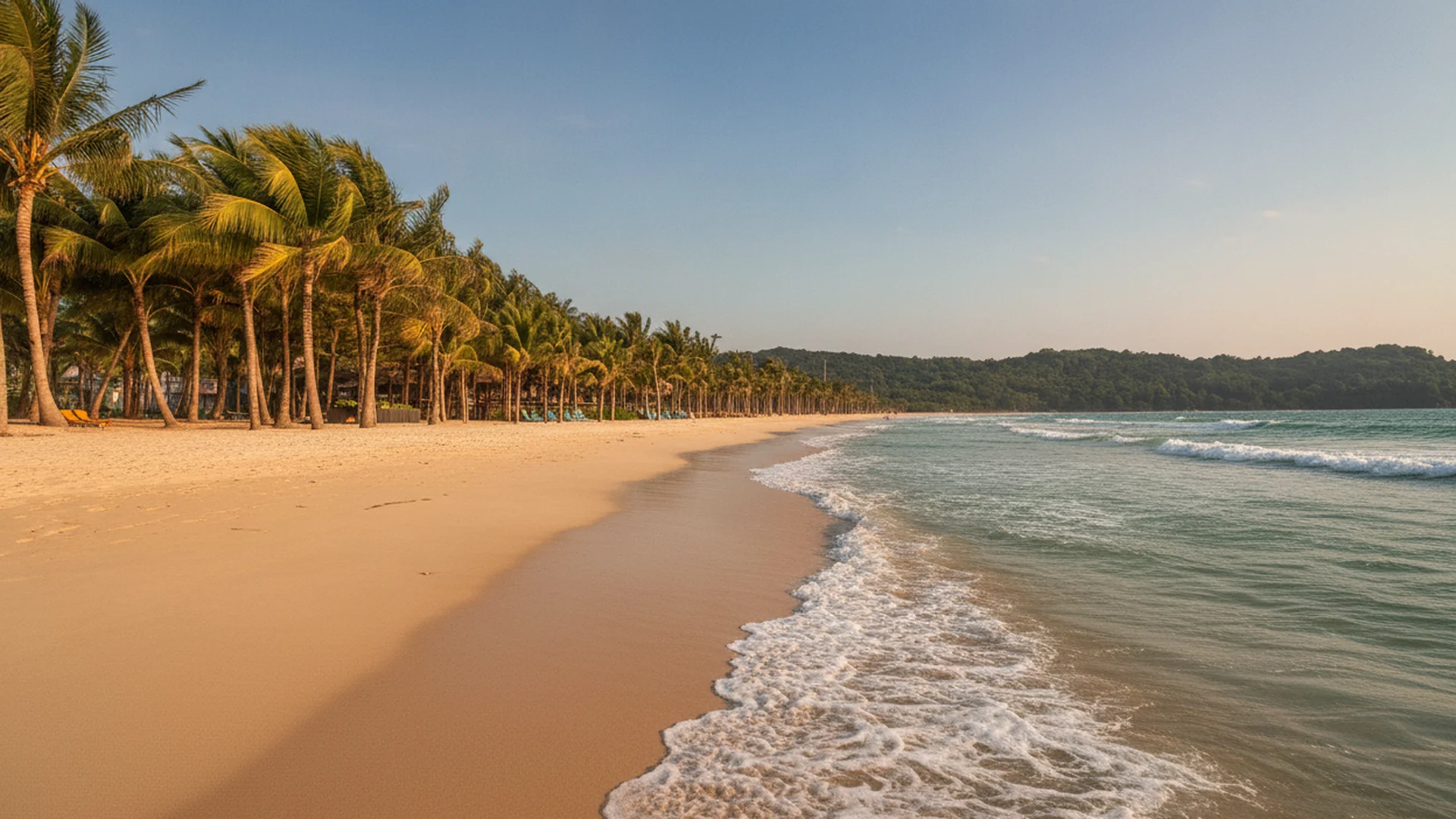
Phu Quoc is Vietnam's largest island, covering 575 km² in the Gulf of Thailand — 11 km off the Cambodian coast and 45 km from the southern mainland. The main island is accompanied by 22 smaller islets, with the administrative center of Duong Dong sitting on the west coast. In June 2025, Phu Quoc was formally designated one of Vietnam's 13 special administrative zones, making it the only island city in the country to hold that status. Its 150-kilometer coastline, characterized by gentle waves and transparent turquoise water, draws visitors seeking water sports, beach time, and island tours in roughly equal measure.
Phu Quoc National Park, established in 2001, covers approximately 31,422 hectares — between 54% and 70% of the island's total land area. In 2006, UNESCO incorporated it as the core terrestrial zone of the Kien Giang Coastal and Island Biosphere Reserve. The park contains over 1,160 plant species and more than 200 animal species, including slow lorises, pig-tailed macaques, and crab-eating macaques on land, and the endangered dugong in coastal waters. More than 60 kilometers of the park's coastline are lined with coral reefs, including 100 species of reef-forming hard corals and 20 species of soft corals.
Tourism accounts for roughly 70% of island employment and generated VND 5,700 billion (approximately USD 247.6 million) in 2019 alone. The sector is supported by Phu Quoc International Airport, which has a passenger capacity of four million arrivals, along with five major fishing ports and high-speed ferry connections to Ha Tien and Rach Gia on the mainland. Long Beach's southwest strip concentrates most of the island's hotels and resorts, including the JW Marriott Phu Quoc Emerald Bay — designed by architect Bill Bensley around a university campus theme — alongside Nam Nghi Resort and Fusion Maia. More secluded eco-stays are available in the Ong Lang area on the central northwest coast.
Key facts & good to know
How do you get to Phu Quoc and how does the 30-day visa exemption work?
Fly from Ho Chi Minh City (45 min) or Hanoi (130 min) to Phu Quoc International Airport, or take a high-speed ferry from Ha Tien (1.5 hrs) or Rach Gia (2.5 hrs). The 30-day visa exemption applies only to direct international arrivals.
The 30-day visa exemption applies exclusively to passengers arriving on direct international flights or transiting through designated international terminals without passing through domestic immigration checkpoints. Travelers who enter Vietnam through another port first and then take a domestic connection to Phu Quoc do not qualify — they fall under standard Vietnamese visa regulations. Always confirm your routing with your airline before booking.
Phu Quoc International Airport has a stated passenger capacity of four million arrivals annually. From the airport, Duong Dong town is roughly 10 km away (approximately 15–20 minutes by taxi), while the northern resort corridor near Ganh Dau sits around 35 km out, adding 40–50 minutes in transit. The southern An Thoi port area is about 20 km from the terminal. Ferry passengers arriving at An Thoi port will need onward transport to their accommodation, so factor in an additional 20–45 minutes depending on destination.
Phu Quoc arrival options: routes, durations, and key figures
| Route | Mode | Duration | Notes |
|---|---|---|---|
| Ho Chi Minh City (SGN) → Phu Quoc (PQC) | Flight | ~45 min | Multiple daily departures; domestic route, no visa exemption benefit |
| Hanoi (HAN) → Phu Quoc (PQC) | Flight | ~130 min | Direct flights available; domestic route |
| Ha Tien → Phu Quoc | High-speed ferry | ~1.5 hrs | Departs from Ha Tien port; schedule varies seasonally |
| Rach Gia → Phu Quoc | High-speed ferry | ~2.5 hrs | Longer crossing; multiple operators |
| Airport → Duong Dong | Taxi/transfer | ~15–20 min | ~10 km |
| Airport → Ganh Dau/North resorts | Taxi/transfer | ~40–50 min | ~35 km |
| Airport → An Thoi (south) | Taxi/transfer | ~20–30 min | ~20 km |
Ferry schedules and availability are reduced or suspended during rough weather in the monsoon season (May–October). Confirm departures in advance.
The 30-day Phu Quoc visa exemption is voided if you transit through any Vietnamese domestic immigration checkpoint before arriving on the island. Travelers connecting via Tan Son Nhat or Noi Bai on a domestic ticket will need a standard Vietnamese visa or e-visa instead. Check this with your airline and the Vietnamese embassy before travel.
Plan a Phu Quoc trip
Where to stay, when to go, and how to combine the highlights of Phu Quoc into a paced stopover.
What are the weather patterns and when is the sea calmest?
The dry season runs November through April, with rainfall under 50 mm/month and calm western waters. The monsoon season spans May through October, bringing up to 400 mm/month of rain and choppy conditions on the west coast.
During the dry season, the western coast — including Long Beach and Ong Lang — sees gentle, swimmable conditions driven by northeast winds. Rainfall stays below 50 mm per month across most of this period, and temperatures range from 25°C to 35°C. Underwater visibility for snorkeling and diving is at its clearest from November to April, making this the practical window for An Thoi archipelago tours.
The monsoon reversal between May and October pushes southwest winds across the Gulf of Thailand, generating swells that make the western coast rough and sometimes unsafe for swimming. Monthly rainfall can reach 400 mm. Notably, the seasonal wind shift changes where debris accumulates: during the northeast winter monsoon, organic material washes onto the east coast, while the southwest summer monsoon pushes debris onto the west coast beaches. Bai Sao on the southeast coast retains calmer, swimmable conditions even during the wet season, making it the practical alternative for travelers visiting outside the dry window.
Seasonal conditions by coast and activity type
| Season | Months | Approx. Rainfall (mm/month) | West Coast Sea State | East Coast Sea State | Snorkeling Viability |
|---|---|---|---|---|---|
| Dry season | Nov–Apr | <50 | Calm, swimmable | Moderate, debris possible | High — best visibility |
| Shoulder / transition | May, Oct | 100–200 | Increasing chop | Calmer than west | Reduced — check conditions |
| Monsoon peak | Jun–Sep | Up to 400 | Choppy, some closures | Calmer, swimmable | Low — tours often suspended |
Rainfall figures are approximate monthly averages. Actual conditions vary year to year; always check local forecasts before booking boat tours.
High-speed ferry services from Ha Tien and Rach Gia, as well as snorkeling speedboat charters to the An Thoi archipelago, can be suspended at short notice during the monsoon season (May–October) when sea states exceed safe operating thresholds. Travelers with fixed itineraries during this period should build in contingency days and check with operators 24–48 hours before departure.
Which accommodation zones fit your logistics and budget?
Four main zones serve different needs: Duong Dong for central access and night markets, Ong Lang for lower-density mid-range stays, the northern Ganh Dau corridor for large resort compounds near theme parks, and An Thoi in the south near ferry ports.
Duong Dong, the island's administrative center on the west coast, sits approximately 10 km from the airport. It provides walking-distance access to the Duong Dong Night Market (open daily roughly 3 PM to 11:30 PM), local restaurants, and Dinh Cau Temple at the northern end of Long Beach. Traffic density is the highest on the island here, and the beach strip running south from the town center is the most developed. Mid-range 3-star hotels in this zone typically run in the USD 40–80/night range, while 5-star properties on the Long Beach strip average USD 180–350/night.
Ong Lang, roughly 20 km from the airport on the central northwest coast, offers a lower-density alternative favored by boutique eco-lodges and mid-range travelers. The area borders the national park, which limits large-scale development. The northern Ganh Dau corridor, at approximately 35 km from the airport, hosts large integrated resort compounds including properties adjacent to VinWonders and the Safari park — expect transfer times of 40–50 minutes from the terminal. An Thoi in the south, also about 20 km from the airport, suits travelers planning multiple ferry trips to the An Thoi archipelago, as it sits close to the southern port departure points.
Accommodation zone comparison: distance, density, and indicative rates
| Zone | Distance from Airport | Character | 3-Star Avg. (USD/night) | 5-Star Avg. (USD/night) |
|---|---|---|---|---|
| Duong Dong | ~10 km | High density, night market access, Long Beach strip | 40–80 | 180–350 |
| Ong Lang | ~20 km | Low density, boutique/eco, national park adjacent | 55–100 | 150–280 |
| Ganh Dau / North | ~35 km | Large-scale resorts, theme park proximity | 70–120 | 200–450 |
| An Thoi / South | ~20 km | Mixed, close to southern ferry ports | 35–70 | 120–220 |
Rate ranges are indicative and based on available market data; actual prices vary significantly by season, booking channel, and specific property.
Where are the primary snorkeling sites and swimmable beaches located?
The An Thoi Archipelago off the southern tip — including May Rut and Gam Ghi islets — is the main snorkeling area. Bai Sao on the southeast coast and Long Beach on the west coast are the primary swimming beaches, each suited to different conditions and visitor volumes.
Bai Sao (Star Beach) on the southeast coast has a shallow gradient and white sand, which keeps wave energy low. It draws a high volume of day-trippers, particularly on weekends and in peak season. Long Beach on the west coast stretches nearly 20 km from Dinh Cau Temple southward and has direct sunset exposure; it is swimmable from November through April when west-coast conditions are calm. During the monsoon months, Bai Sao remains the more reliable swimming option as the east coast is sheltered from southwest swells.
The An Thoi Archipelago, consisting of 15 islands off the southern tip, is the practical hub for snorkeling. Key sites around May Rut Islet and Gam Ghi Islet offer reef systems with approximately 41% coral coverage including both hard and soft coral species. Standard shared speedboat itineraries typically run around 4 hours and cover multiple islets in sequence, with passenger capacities that vary by vessel type: traditional wooden boats generally carry 20–30 passengers at slower speeds, while speedboats carry 8–15 passengers and cover distances more quickly. Private charters provide itinerary flexibility but at a significantly higher per-person cost. The Hon Thom Cable Car — approximately 7,899 meters long with a 15-minute one-way transit — connects the main island to Hon Thom Island, which also has beach facilities.
Shared and private boat tours to the An Thoi archipelago snorkeling sites operate reliably only during the dry season (November–April). From May through October, operators regularly cancel departures due to sea conditions without advance notice. Travelers should avoid pre-paying non-refundable snorkeling packages for monsoon-season dates and confirm departure status with the operator on the morning of the tour.
What land tours and attractions operate on the island?
A standard half-day land tour covers a pepper farm, a fish sauce facility, and Duong Dong Night Market in roughly 4 hours. Larger attractions — VinWonders and the Safari park in the north — each require 4–6 hours. The Hon Thom Cable Car takes 15 minutes one way over 7,899 meters.
A typical 4-hour half-day land tour sequences three stops: an operational pepper farm where guides explain cultivation and drying processes, a fish sauce barrel house demonstrating the fermentation of anchovies that underpins Phu Quoc's fish sauce industry, and the Duong Dong Night Market, open daily from approximately 3 PM to 11:30 PM, where stalls sell fresh seafood, locally produced fish sauce, Phu Quoc pepper, and pearls. This format fits a morning or afternoon slot and requires no significant physical exertion, making it viable for most visitors regardless of fitness level.
The northern resort corridor near Ganh Dau hosts two large-scale theme parks: VinWonders and the Phu Quoc Safari park. Both typically require 4–6 hours to cover adequately, so combining them in a single day is impractical for most visitors. Budget a full day for each if attendance is a priority. The Hon Thom Cable Car, at approximately 7,899 meters in length, carries passengers from An Thoi port area to Hon Thom Island in about 15 minutes each way, providing access to beach facilities and the water park on the island. Operators schedule daily maintenance pauses, so confirm current operational hours and any mid-day suspension windows directly with the cable car operator before planning your visit.
The Hon Thom Cable Car undergoes scheduled daily operational pauses for maintenance. The exact timing of these pauses can change by season or management decision. Travelers who arrive during a suspension window may face waits of 30–60 minutes or longer. Check the current daily schedule with the operator or your accommodation on the morning of your visit to avoid disruption to onward plans.
Phu Quoc attractions & tickets
Pre-purchased entrance tickets, private transfers and certified guides — no queues, no logistics hassle.
Building a phu-quoc itinerary for your clients?
Send us your dates and pace — we return a realistic, booked-and-paced plan with net rates, not a generic template.
Want this tailored to your dates?
We run these routes ourselves. Send your dates, group size and pace and our Hanoi team will build a custom version — with real prices, not estimates.
Frequently asked questions
People also ask
Verified sources
- ATL DMC booking log · 12,000+ trips since 2011
- Vietnam National Administration of Tourism – Phu Quoc Destination Page · https://vietnam.travel/places-to-go/southern-vietnam/phu-quoc
- Vietnam National Administration of Tourism – Beachy, Beautiful Phu Quoc · https://vietnam.travel/things-to-do/beachy-beautiful-phu-quoc
- Vietnam National Administration of Tourism – UNESCO Kien Giang Biosphere Reserve · https://vietnam.travel/things-to-do/the-unesco-kien-giang-biosphere-reserve
- Vietnam Tourism Authority (Vietnamtourism.gov.vn) – Phu Quoc Island from Above · https://vietnamtourism.gov.vn/en/post/15202
- Wikipedia – Phú Quốc · https://en.wikipedia.org/wiki/Ph%C3%BA_Qu%E1%BB%91c
- Vietnam Briefing – Phu Quoc: Key Investment Destination · https://www.vietnam-briefing.com/news/vietnams-phu-quoc-island-key-investment-destination-tourism-industry.html/
- International Parks – Phu Quoc National Park · https://www.internationalparks.org/vietnam/Phu%20Quoc
Turn this guide into a trip
The products we actually run for this route — book direct, no OTA markup.
Plan your custom trip with Phuong Le
Phuong Le
“Tell us your dates and pace — we'll turn this guide into a realistic, booked-and-paced trip for you, not a generic template.”
Plan my trip with our team →About the authors
Phuong Le · primary author
Specialty: Hanoi · Halong Bay · Vietnam itineraries.
Cross-category lattice
Plan your trip
Practical
Related travel guides
1× per month · pillar guides + new itineraries
Get our newest pillar guides + quarterly itinerary updates delivered. No spam, no promotions, just travel-guide content. Unsubscribe anytime.