Quick answer
Open daily 8:00-17:00; tickets 30,000 VND (adult). Quietest: Tue-Thu at opening and 16:00-17:00. Don't miss Khue Van Cac and the Doctor Stelae. From the Old Quarter: 2 km (25 min) walk or 10 min by taxi/Grab. Dress shoulders/knees; no flash inside; don't touch stelae.
Why this guide
About this guide
The Temple of Literature (Văn Miếu – Quốc Tử Giám) stands in central Hanoi as one of Vietnam's oldest surviving educational institutions. Emperor Lý Thánh Tông founded the complex in 1070 to honour Confucius and his disciples, and six years later Emperor Lý Nhân Tông added the Imperial Academy — Vietnam's first national university — within its walls. Initially reserved for royalty and the elite, the Academy opened to talented commoners from 1253 under the Trần dynasty and continued operating for over 700 years until 1779, when the Nguyễn dynasty relocated the capital and its academy to Huế.
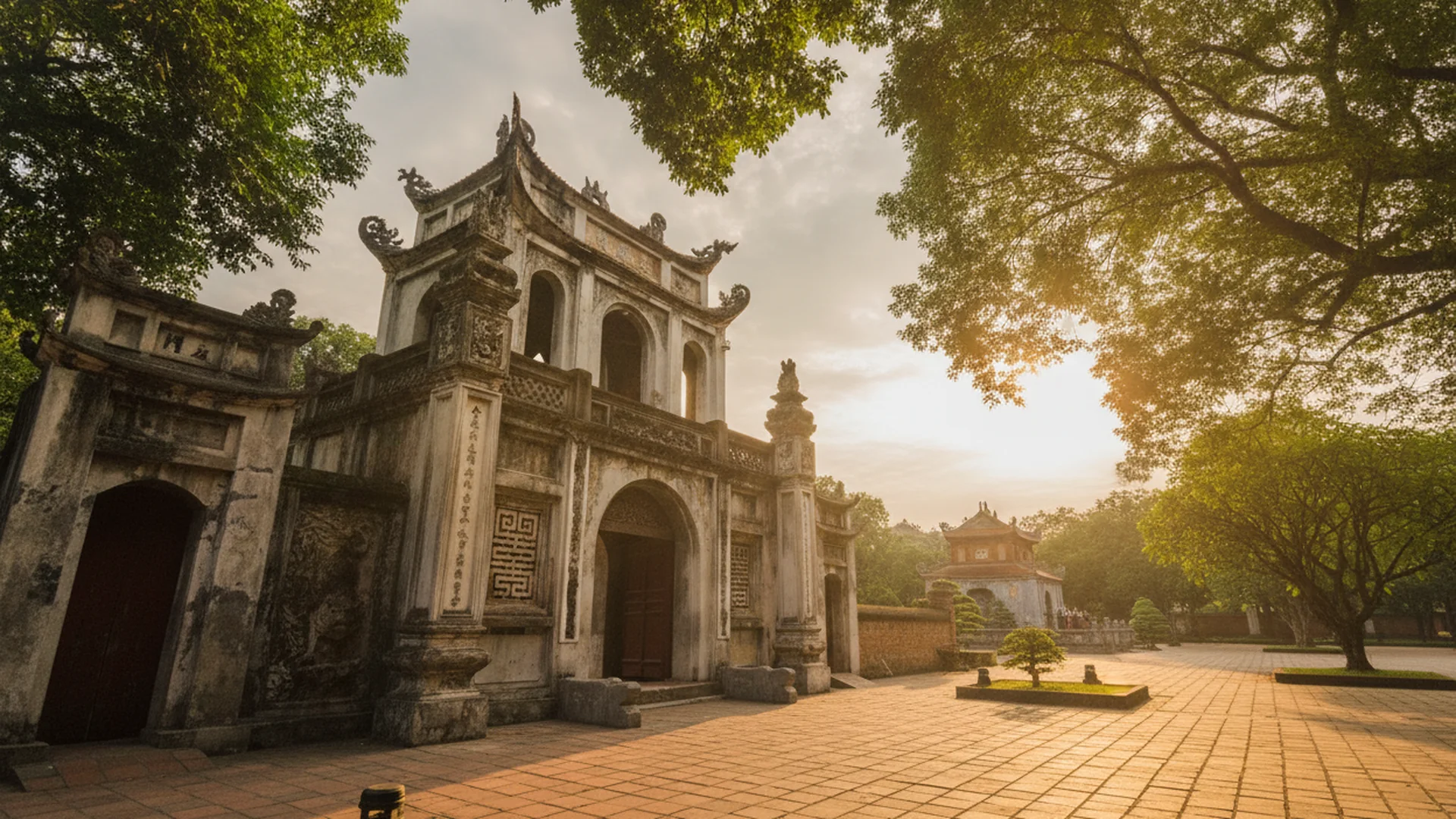
Covering 54,331 m², the complex is arranged across five successive courtyards on a north–south axis, its layout modelled on Confucius's birthplace in Qufu, Shandong, China. The Khuê Văn Các, a pavilion built in 1805, serves as the official symbol of Hanoi and appears on the reverse of Vietnam's 100,000 VND banknote. In the third courtyard, 82 stone Doctor's Stelae — mounted on stone tortoises and recording doctoral graduates from 1442 to 1779 — were inscribed in UNESCO's Memory of the World Register in 2011. Under French rule, the site was registered as a Monument historique in 1906; wartime bombing between 1946 and 1954 caused damage that has since been repaired through restoration work.
The temple is open daily from 08:00 to 17:00, with summer hours (15 April–15 October) starting at 07:30; the last ticket is sold 30 minutes before closing. Daytime entry costs approximately 70,000 VND for adults, 35,000 VND for students with valid ID, and is free for children under 15. Since 2024, night tours run Wednesday, Saturday, and Sunday from 18:30 to 22:30, featuring 3D projection light shows, with tickets priced at around 199,000 VND for adults and 99,000 VND for children. The ticket counter is cash only — Vietnamese Dong is required — and a thorough visit typically takes 60 to 90 minutes. Modest dress is expected: no sleeveless tops, shorts, or short skirts, and hats must be removed inside sanctuary areas. Photography is permitted; drones are not.
Key facts & good to know
What are the opening hours, ticket prices, and quiet times at the Temple of Literature?
The Temple of Literature opens daily 08:00–17:00 (last ticket 16:30). Adult admission is 70,000 VND; students with valid ID pay 35,000 VND; children under 15 enter free. The quietest window is 08:00–09:00 on weekdays.
The ticket counter operates Monday through Sunday, 08:00–16:30. During the summer period (15 April–15 October) the gates may open from 07:30. The site stays open on Vietnamese public holidays, which is worth noting when planning around Tết — demand for access spikes considerably during that period. Cash only is accepted at the counter; card payments are not available, so carry Vietnamese Dong before you arrive.
Night tours launched in 2024 run Wednesday, Saturday, and Sunday from 18:30 to 22:30 and include 3D projection light shows across the courtyards. Night-tour tickets are priced separately at approximately 199,000 VND for adults and 99,000 VND for children. These sessions operate on a different atmosphere and footfall pattern to daytime visits and require a separate ticket purchase.
For daytime visits, the two quietest windows are right at opening (08:00) and after 14:00 on weekdays, when organised tour groups are largely absent. The busiest period runs 09:00–11:00 daily and across full weekends. Two specific seasonal peaks stand out: the Tết (Lunar New Year) holiday, when students visit to seek Confucian blessings before university entrance exams, and November, when graduating university students use the complex as a backdrop for official graduation photography sessions.
Ticket types and session options
| Visitor category | Session | Price (VND) | Hours |
|---|---|---|---|
| Adult | Daytime | 70,000 | 08:00–17:00 (last entry 16:30) |
| Student (valid ID) | Daytime | 35,000 | 08:00–17:00 (last entry 16:30) |
| Child under 15 | Daytime | Free | 08:00–17:00 (last entry 16:30) |
| Adult | Night tour | 199,000 | 18:30–22:30 (Wed, Sat, Sun) |
| Child | Night tour | 99,000 | 18:30–22:30 (Wed, Sat, Sun) |
Cash (Vietnamese Dong) only at the ticket counter. Summer daytime opening may shift to 07:30 between 15 April and 15 October.
Plan a Hanoi trip
Where to stay, when to go, and how to combine the highlights of Hanoi into a paced stopover.
What is the history of the Temple of Literature and what will you find inside each of the five courtyards?
Founded in 1070 by Emperor Lý Thánh Tông to honour Confucius, the complex became Vietnam's first national university in 1076. It operated for over 700 years across five successive courtyards containing gates, pavilions, 82 stone Doctor Stelae, and a main sanctuary.
Emperor Lý Thánh Tông established the temple in 1070 as a place of Confucian worship. Six years later, Emperor Lý Nhân Tông added the Imperial Academy (Quốc Tử Giám) within the same grounds — Vietnam's first state university — initially reserved for royalty and the elite. From 1253, under the Trần dynasty, talented commoners were also admitted. The academy ran continuously for over 700 years until 1779, when the Nguyễn dynasty relocated the capital and the academy to Huế.
Under French colonial administration the complex was classified as a Monument historique in 1906. Wartime bombing between 1946 and 1954 caused significant structural damage, though restoration work has since addressed much of it. The entire site covers 54,331 m² and is laid out on a north–south axis modelled on Confucius's birthplace in Qufu, Shandong, China.
The third courtyard holds the most historically significant element: the Thiên Quang Well (Well of Heavenly Clarity) flanked by 82 stone Doctor Stelae mounted on stone tortoises. These stelae record the names of doctoral graduates from 1442 to 1779 and were inscribed in UNESCO's Memory of the World Register in 2011. The Khuê Văn Các pavilion — built in 1805 and now the official symbol of Hanoi — appears on the reverse of Vietnam's 100,000 VND banknote and marks the entrance to the second courtyard.
Primary feature of each of the five courtyards
| Courtyard | Primary feature | Key detail |
|---|---|---|
| First | Văn Miếu Gate (main entrance) | Triple-arched ceremonial gate on Quoc Tu Giam Street |
| Second | Khuê Văn Các Pavilion | Built 1805; official symbol of Hanoi; depicted on 100,000 VND banknote |
| Third | Thiên Quang Well and 82 Doctor Stelae | Stelae on stone tortoises record doctoral graduates 1442–1779; UNESCO Memory of the World 2011 |
| Fourth | Đại Thành Gate and main worship courtyard | Entry to the principal ritual zone flanked by side halls |
| Fifth | Đại Thành Sanctuary and Imperial Academy | Main Confucian altar and the original Imperial Academy building |
Courtyards progress south to north along a single linear axis. Visitors move through each in sequence.
How long does a visit take and do you need a guide?
A standard walk-through of all five courtyards takes 45 to 60 minutes. An official audio guide (50,000 VND, available in 14 languages) extends that to around 75–90 minutes. A local guide adds contextual detail on stelae inscriptions and exam procedures that neither self-guided option provides.
Walking the five courtyards without stopping for detail takes roughly 45 minutes at a comfortable pace. Factoring in reading bilingual signage, examining individual stelae, and pausing at the Khuê Văn Các pavilion, most independent visitors spend 60–75 minutes on site. The complex's linear layout means there are no branches or dead ends; you simply progress from the entrance gate northward to the sanctuary.
The official audio guide is available at the ticket area for approximately 50,000 VND and covers commentary in 14 languages. It provides narrative context at each major stop and is a practical option for independent travellers who want background without coordinating a guide. Using the full audio guide typically adds 20–30 minutes to the visit duration.
A local guide brings capabilities the audio guide does not: translation of specific stelae inscriptions (which are in classical Chinese characters), explanations of the Confucian examination system's three-tier structure, and contextualisation of why particular graduates appear on specific turtles. This is particularly relevant if you are visiting with students of Vietnamese history or taking an academic interest in the site rather than a general overview. Local guides are bookable through licensed DMCs or can be arranged through the site's visitor services desk.
Comparison of visit methods
| Method | Estimated duration | Cost (VND) | Best for |
|---|---|---|---|
| Independent / self-guided | 45–60 minutes | 0 (entry only) | Visitors with prior background or limited time |
| Official audio guide | 75–90 minutes | 50,000 | Solo or small-group visitors wanting structured narrative in 14 languages |
| Local licensed guide | 90–120 minutes | Varies by provider | Groups wanting stelae inscription translation and exam-system context |
Entry fee (70,000 VND adults) is additional to audio guide or guide costs. Audio guide availability should be confirmed at the ticket counter on arrival.
How do you get to the Temple of Literature from the Hanoi Old Quarter?
The Temple of Literature sits roughly 2 km west of Hoan Kiem Lake. Walking takes 25–30 minutes; a Grab or metered taxi takes 10–15 minutes and costs approximately 40,000–60,000 VND. The main entrance is on Quoc Tu Giam Street.
From the Old Quarter, the most direct walking route follows Hang Bong Street westward, continuing through Cua Nam and along Nguyen Khuyen Street before reaching Quoc Tu Giam Street. The walk is flat and largely pedestrian-friendly, though traffic crossings on major junctions require attention. At 25–30 minutes on foot, it is a practical option during cooler morning hours (October–April) but less comfortable in the midday heat of summer months.
Grab and metered taxis cover the 2 km in 10–15 minutes depending on traffic, at a typical fare of 40,000–60,000 VND. Request drop-off at the Quoc Tu Giam Street entrance specifically; GPS pins for the complex sometimes default to a side street. The Vietnam National Fine Arts Museum is located approximately 300 metres from the Temple of Literature on Nguyen Thai Hoc Street, making it a natural pairing for a half-day itinerary in this district.
Several city bus lines serve the area. Bus routes stopping near the temple include lines serving the Quoc Tu Giam or Van Mieu stops — confirm current route numbers through the Hanoi Bus app or at your accommodation, as line designations are periodically revised. The surrounding Dong Da district also contains the Vietnam Museum of Ethnology (approximately 3 km further west) and the B-52 Victory Museum (roughly 1.5 km north), which can be combined in a full-day programme.
Quoc Tu Giam Street narrows in front of the main gate and does not have a formal taxi or rideshare pull-in zone. Grab drivers may stop 50–100 metres short of the entrance. Confirm the drop-off point before booking and allow extra time during the 07:30–09:00 school-run period when the surrounding streets carry heavy motorbike and bus traffic. Returning via Grab: request pick-up from the Quoc Tu Giam Street address rather than a map pin to avoid drivers locating the wrong gate.
What are the dress code rules, etiquette requirements, and wheelchair accessibility limits?
Shoulders and knees must be covered; tank tops, shorts, and short skirts are not permitted. Hats must be removed inside sanctuary areas. Touching the stone tortoises is strictly prohibited. Courtyards 1–4 have ramp access; the fifth courtyard requires navigating stairs.
The dress code is enforced at the entrance gate. Visitors in sleeveless tops, shorts, or short skirts will be refused entry or asked to use sarong wraps, which may be available at the gate but are not guaranteed. Carrying a lightweight layer or scarf is the most reliable solution, particularly if you plan to visit in warm weather. Inside the Đại Thành Sanctuary — the main altar hall in the fifth courtyard — hats must be removed and voices kept low. Mobile phone calls near the altars are considered disrespectful and staff will ask visitors to move.
The 82 stone Doctor Stelae and their tortoise bases are protected monuments. Touching, leaning on, or placing objects on the tortoises is explicitly prohibited and has been a point of enforcement since the UNESCO inscription in 2011. Photography of the stelae is permitted from standing distance. Drones are banned throughout the complex.
On wheelchair and stroller access: side paths in courtyards one through four incorporate ramps that allow navigation without steps. The transition between these courtyards involves level or gently sloped surfaces. The fifth courtyard — containing the Đại Thành Sanctuary and the original Imperial Academy building — requires ascending a set of stairs at the Đại Thành Gate. There is no lift or alternative ramped route into this final courtyard at the time of writing, so visitors using wheelchairs or pushchairs will not be able to access the sanctuary interior.
The Đại Thành Gate entrance to the fifth (final) courtyard involves a staircase with no current ramped alternative. Wheelchair users, visitors with limited mobility, and those with pushchairs can access courtyards 1–4 via side ramps but will be unable to enter the sanctuary building or the Imperial Academy hall without assistance over steps. Confirm current accessibility provisions with the site visitor services desk before your visit, as restoration work periodically alters available routes.
Hanoi attractions & tickets
Pre-purchased entrance tickets, private transfers and certified guides — no queues, no logistics hassle.
Building a hanoi itinerary for your clients?
Send us your dates and pace — we return a realistic, booked-and-paced plan with net rates, not a generic template.
Want this tailored to your dates?
We run these routes ourselves. Send your dates, group size and pace and our Hanoi team will build a custom version — with real prices, not estimates.
Frequently asked questions
People also ask
Verified sources
- ATL DMC booking log · 12,000+ trips since 2011
- Wikipedia – Temple of Literature, Hanoi · https://en.wikipedia.org/wiki/Temple_of_Literature,_Hanoi
- Vietnam Airlines – Temple of Literature Travel Guide · https://www.vietnamairlines.com/us/en/plan-book/travel/travel-guide/temple-of-literature
- VietGo – Temple of Literature Visitor Guide 2026 · https://viet-go.com/en/attractions/temple-of-literature-hanoi-guide
- Your Vietnam Travel – Temple of Literature Complete Guide (updated Mar 2026) · https://www.yourvietnamtravel.com/temple-of-literature-hanoi
- Vietnam Discovery – Temple of Literature: History, Hours, Ticket, Dress Code · https://vietnamdiscovery.com/hanoi/attractions/temple-of-literature/
- Na Land / Hanoi Residents – Temple of Literature Opening Hours · https://hanoi-residents.com/temple-of-literature-hanoi-opening-hours-everything-tourists-need-to-know/
- Vietnam Story – Van Mieu Quoc Tu Giam Visitor Guide 2025 · https://vietnamstory.in/temple-of-literature/
Turn this guide into a trip
The products we actually run for this route — book direct, no OTA markup.
Plan your custom trip with Phuong Le
Phuong Le
“Tell us your dates and pace — we'll turn this guide into a realistic, booked-and-paced trip for you, not a generic template.”
Plan my trip with our team →About the authors
Phuong Le · primary author
Specialty: Hanoi · Halong Bay · Vietnam itineraries.
Cross-category lattice
Plan your trip
Practical
Related travel guides
1× per month · pillar guides + new itineraries
Get our newest pillar guides + quarterly itinerary updates delivered. No spam, no promotions, just travel-guide content. Unsubscribe anytime.