Quick answer
Go Dec–Apr for dry weather. Base in Can Tho. From HCMC: bus 3–5 hrs (VND 150k–250k). Sunrise boats 5–7am; tours VND 250k–800k (shared vs private). Sleep at family homestays in Can Tho/Ben Tre/Chau Doc. Pack sun cover, small bills; ask before photos; avoid plastic; tip boat crew.
Why this guide
About this guide
The Mekong Delta covers over 40,500 km² in southwestern Vietnam — roughly 12.8% of the country's total land area — where the Mekong River splits into two main branches, the Tiền and the Hậu, before fanning out into nine distributaries collectively called the 'Nine Dragons.' Spanning 13 provinces and one centrally governed city, Can Tho, the delta was home to approximately 17.7 million people as of 2022. It produces around half of Vietnam's total rice output and supplies about 70% of the country's tropical fruit, which explains why the region is commonly referred to as Vietnam's Rice Bowl.
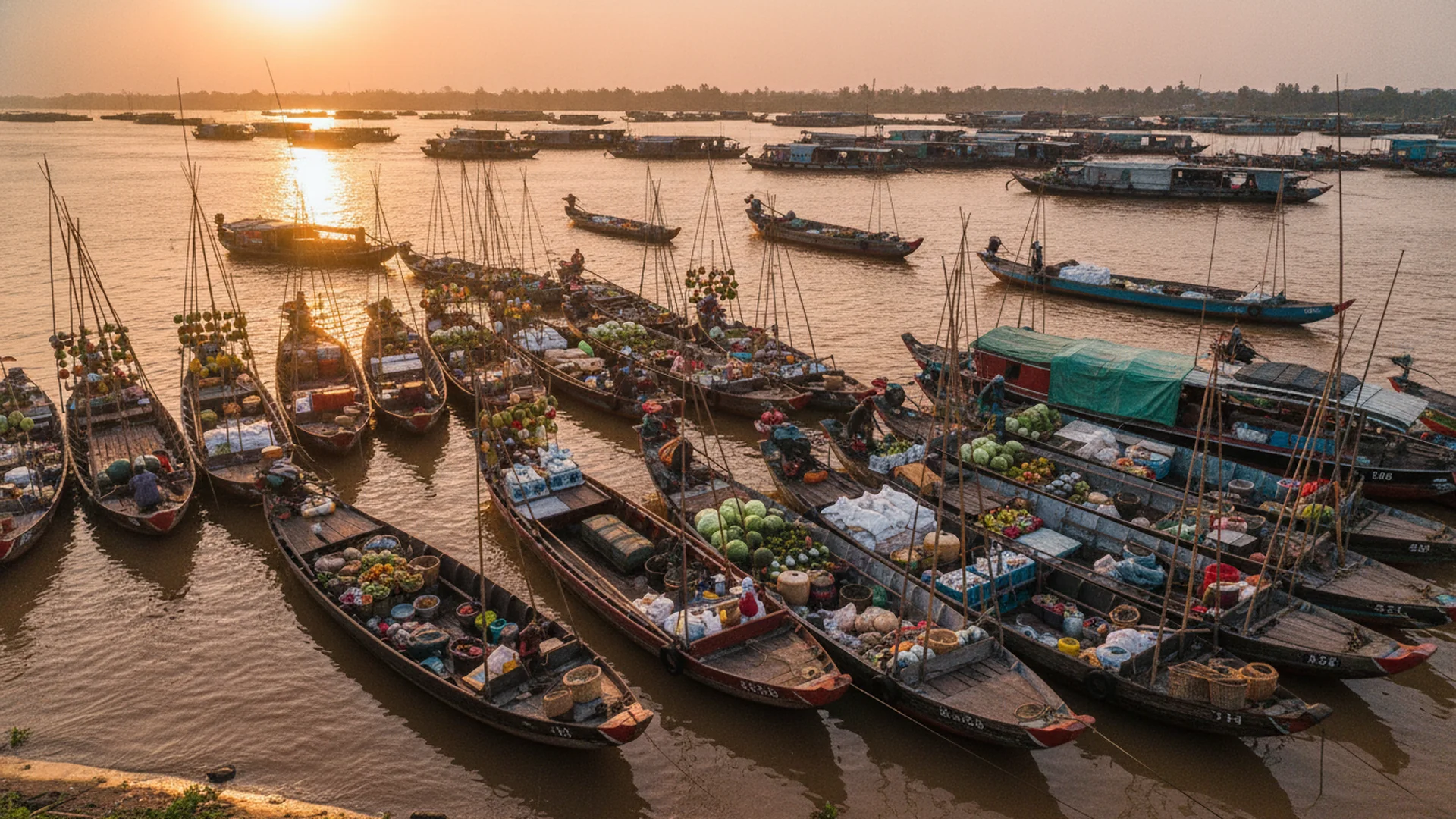
Floating markets in the Mekong Delta are thought to have emerged in the early 19th century, when reclaimed waterways served as the primary transport routes across the southern region. By the early 20th century, markets along the Hậu and Tiền rivers — including Cái Răng, Ngã Bảy, and Ngã Năm — had reached what researchers describe as a golden age, with hundreds of boats gathering daily to trade fruit, rice, and agricultural goods. A defining characteristic of these markets is the cây bẹo, a tall bamboo pole from which sample goods are hung so buyers can identify what each boat is selling from a distance. Road construction and urbanisation since the 1990s have reduced the number of boats at many markets, and tourism now plays a significant role in sustaining those that remain.
Cái Răng, located on the Cần Thơ River approximately 6–7 km from Can Tho city centre, is the largest floating market in the delta and accessible only by boat from Ninh Kiều Wharf. It was officially recognised as a national intangible cultural heritage by Vietnam's Ministry of Culture, Sports, and Tourism in June 2016. The market typically draws 300–500 local boats per day, with wholesale trading of fruits, vegetables, and agricultural products concentrated between 4 and 6 AM. Other significant markets include Ngã Năm in Sóc Trăng — which opens as early as 3 AM at the convergence of five canals — and Cái Bè in Tiền Giang, best visited before 8 AM where the Tiền River borders three provinces.
Key facts & good to know
How do you travel from Ho Chi Minh City to the Mekong Delta and Cambodia?
Futa Bus sleeper services and private vehicle charters are the two main options. Drive times run 2 hours to Ben Tre, 3.5–4 hours to Can Tho, and 6 hours to Chau Doc, where a 7:30 AM speedboat crosses to Phnom Penh in 5 hours.
Futa Bus Lines (Phuong Trang) runs air-conditioned coaches from Ho Chi Minh City's Mien Tay terminal to Can Tho and Chau Doc multiple times daily. Seats on these routes are inexpensive, but departure and arrival times are fixed, which matters when you need to position yourself for an early-morning floating market visit. Private vehicle charters give you control over stops and timings — useful for covering multiple provinces in a single day — at a considerably higher cost.
From Chau Doc, the border crossing into Cambodia uses the Vinh Xuong/Kaam Samnor river checkpoint. Victoria Boats and Hang Chau operate the speedboat service; both require passengers to board by 7:30 AM. The transit covers roughly 100 km of river and takes approximately 5 hours to reach Phnom Penh, including border formalities. Visas on arrival are available for most nationalities at this crossing, but confirm current requirements before travel.
Ho Chi Minh City to Mekong Delta & Cambodia: Transport Comparison
| Route | Distance (approx.) | Drive/Transit Time | Futa Bus Fare (approx.) | Private Charter (approx.) |
|---|---|---|---|---|
| HCMC → Ben Tre | 85 km | 2 hours | Not served directly | 1,500,000–2,000,000 VND |
| HCMC → Can Tho | 170 km | 3.5–4 hours | 150,000–200,000 VND | 2,500,000–3,500,000 VND |
| HCMC → Chau Doc | 245 km | 6 hours | 200,000–250,000 VND | 3,500,000–5,000,000 VND |
| Chau Doc → Phnom Penh (speedboat) | ~100 km river | 5 hours (incl. border) | ~450,000–550,000 VND | N/A — fixed operator service |
Futa Bus fares and charter costs are market estimates; confirm current rates at time of booking. Ferry crossings on provincial roads add 15–30 minutes to road journey estimates.
Plan a Vietnam trip
Where to go, when to travel, and how a local ground operator builds a paced Vietnam itinerary.
What are the physical differences between Cai Rang and Phong Dien floating markets?
Cai Rang is a wholesale hub with large motorized barges, active 5:00–8:00 AM, about 6–7 km from Can Tho centre. Phong Dien is a smaller retail market of non-motorized rowboats, peaking earlier from 4:00–6:00 AM.
Cai Rang operates on the Can Tho River and draws 300–500 boats on a typical day, predominantly large motorized barges trading fruit, vegetables, and agricultural products in bulk. Each boat hangs samples of its cargo from a tall bamboo pole — called a cây bẹo — so buyers can identify goods from a distance without pulling alongside every vessel. The scale of the operation means the atmosphere between 5:00 and 6:30 AM is genuinely commercial rather than performed; by 9:00 AM wholesale activity winds down and tourist boat traffic begins to dominate. In June 2016 the Vietnamese Ministry of Culture formally recognised Cai Rang as a national intangible cultural heritage.
Phong Dien, located further from Can Tho city, draws smaller non-motorized rowboats selling directly to individual buyers, giving it a more intimate character. Because the boats are smaller and the trade is retail, the peak window of 4:00–6:00 AM is earlier and shorter. Both markets are reached by chartering a small sampan from Ninh Kieu Wharf in Can Tho; boat charter costs typically run 300,000–600,000 VND depending on duration and negotiation. Breakfast boats circulate through both markets selling hu tieu noodle soup and iced milk coffee directly from the boat.
Cai Rang vs. Phong Dien Floating Market: Key Differences
| Factor | Cai Rang | Phong Dien |
|---|---|---|
| Market type | Wholesale | Retail |
| Boat type | Large motorized barges | Small non-motorized rowboats |
| Peak hours | 5:00 AM – 8:00 AM | 4:00 AM – 6:00 AM |
| Distance from Ninh Kieu Wharf | 6–7 km by boat | Farther; longer charter required |
| Boat charter cost (from Ninh Kieu) | 300,000–600,000 VND | 300,000–600,000 VND |
| Entry ticket | None required | None required |
| Heritage status | National intangible cultural heritage (2016) | None formally designated |
Charter prices vary by season and negotiation. Hiring a private sampan rather than joining a shared tour gives more flexibility on timing.
Where are the primary homestay zones and what amenities do they actually provide?
Ben Tre and An Binh island near Vinh Long are the two main homestay zones. Expect open-air structures with fans, mosquito nets, and shared bathrooms rather than air conditioning. Rates typically run 300,000–800,000 VND per night including a set-menu dinner.
Ben Tre, roughly 85 km from Ho Chi Minh City, sits within a network of narrow coconut-lined canals on islands formed by the Tien River's distributaries. Its proximity to the city makes it the most accessible overnight option for a short trip. Homestays here are generally family-run wooden or brick structures built on the canal edge; the standard setup includes a sleeping room with fan and mosquito net, shared toilet and shower facilities, and a communal dining area where the host family prepares meals. Bicycle use for exploring local paths and a short sampan ride on the canal are routinely included in the nightly rate.
An Binh island in Vinh Long province is reached by a short ferry crossing from Vinh Long town, which itself is accessible via Cai Be on the Tien River. The island is covered in fruit orchards — longan, mango, and rambutan depending on the season — and the homestays here follow the same physical format as Ben Tre: open-air, fan-cooled, shared bathrooms. Set-menu dinners typically feature elephant ear fish (ca tai tuong) grilled or fried and served wrapped in rice paper with herbs, along with river shrimp and seasonal vegetables. Rates across both zones run 300,000–800,000 VND per night; the lower end reflects the most basic shared-bathroom rooms, while the upper end covers rooms with private bathrooms in newer family guesthouses.
Ben Tre vs. An Binh/Vinh Long Homestay Zones
| Factor | Ben Tre | An Binh / Vinh Long |
|---|---|---|
| Distance from HCMC | ~85 km (2 hours) | ~135 km (3 hours via Cai Be) |
| Landscape character | Coconut canals, delta waterways | Fruit orchards, Tien River islands |
| Access to island | Direct road and bridge | Short ferry from Vinh Long town |
| Typical rate per night | 300,000–800,000 VND | 300,000–800,000 VND |
| Air conditioning | Generally not available | Generally not available |
| Bathroom type | Shared in most properties | Shared; some private at higher rate |
| Standard inclusions | Bicycle use, sampan ride, set dinner | Bicycle use, sampan ride, set dinner |
Rates are per room/person depending on operator — confirm at booking. Amenities vary significantly between individual family homestays; inspect the room before committing.
How should you sequence a 2-night itinerary from Ho Chi Minh City to Chau Doc?
Night 1 at a Ben Tre or Vinh Long homestay; Night 2 in Can Tho near Ninh Kieu Wharf. Rise at 4:30 AM on Day 3 for Cai Rang market, then transfer directly to Chau Doc to board the 7:30 AM Cambodia speedboat the following morning.
On Day 1, depart Ho Chi Minh City in the morning to allow time for afternoon cycling and a canal sampan ride before your first night's homestay. Ben Tre is the quicker option at roughly 2 hours; Vinh Long adds about an hour but places you closer to Can Tho for Day 2. Either way, a late-morning departure from the city gives you a full afternoon in the delta before dark.
On Day 2, check out of your homestay after breakfast and transfer to Can Tho, aiming to arrive by early afternoon so you can orient yourself around Ninh Kieu Wharf before dark. Staying in a hotel rather than a second homestay makes a 4:30 AM wake-up for Day 3 considerably more practical. Confirm your boat charter for the following morning with a wharf operator the evening before.
On Day 3, take the boat to Cai Rang market from 5:00 AM, return to Ninh Kieu by 8:00 AM, and begin the roughly 3-hour road transfer to Chau Doc immediately. Arriving in Chau Doc by midday leaves the afternoon free before the mandatory 7:30 AM departure the next morning for the Phnom Penh speedboat. Note that road segments between provinces in the delta frequently pass through single-lane stretches and require short ferry crossings, meaning actual travel times regularly exceed what a map distance suggests.
Travel times between Mekong Delta provinces consistently exceed map estimates. Single-lane rural roads, traffic at provincial town centres, and mandatory short ferry crossings (some with 20–40 minute waits during peak hours) add significant time. Build at least 30–60 minutes of buffer into every inter-province transfer, particularly on the Can Tho to Chau Doc leg, which must be completed the day before the 7:30 AM Cambodia speedboat departure — there is no later service.
How do water levels and the Tet holiday alter travel conditions in the Mekong Delta?
The dry season (December–April) gives the widest fruit variety at markets and calm waterways. Flood season (September–November) brings higher water and afternoon downpours that can stop small sampan trips. Floating markets close completely for 3–4 days during Tet.
The Mekong Delta's dry season runs December through April, corresponding to the period when tropical fruit variety at markets peaks and waterways remain calm enough for reliable small-boat travel. The flood season from September through November raises water levels across the delta — which opens up some normally inaccessible waterways — but also brings short, heavy afternoon rainstorms that can make open sampan rides impractical or unsafe. Morning departures before noon reduce exposure to afternoon downpours during this period.
Tet (Lunar New Year), which falls in late January or February, represents the single largest disruption to delta travel. Floating markets including Cai Rang shut down entirely for 3 to 4 days around the holiday as boat operators return to their families. In the two weeks before Tet, roads near Sa Dec — known for its flower nurseries supplying the holiday market — carry noticeably heavier traffic, which extends drive times on routes passing through Dong Thap province. Visitors planning to see floating markets should schedule their trip either well before or after the Tet period.
Floating markets close completely for 3–4 days during Tet; exact dates shift each year with the lunar calendar — verify the specific closure window before booking. During flood season (September–November), small sampan operators may decline trips or cut them short due to afternoon storms and fast-moving currents on exposed river sections. Always confirm departure conditions with your boat operator on the morning of travel rather than relying on prior arrangements.
Browse Vietnam tours
Ready-made and tailor-made tours run by our own ground operators — private vehicles, certified guides, net rates.
Building a vietnam itinerary for your clients?
Send us your dates and pace — we return a realistic, booked-and-paced plan with net rates, not a generic template.
Want this tailored to your dates?
We run these routes ourselves. Send your dates, group size and pace and our Hanoi team will build a custom version — with real prices, not estimates.
Frequently asked questions
People also ask
Verified sources
- ATL DMC booking log · 12,000+ trips since 2011
- Vietnam National Tourism – How to Travel the Mekong Delta · https://vietnam.travel/things-to-do/how-to-travel-mekong-delta
- Can Tho City Tourism – Cái Răng Floating Market · https://canthotourism.vn/en/chocairang
- Báo Cần Thơ – Cái Răng Floating Market, Vietnam's Intangible Cultural Heritage · https://baocantho.com.vn/news/cai-rang-floating-market-vietnams-intangible-cultural-heritage-a88807.html
- Wikipedia – Floating Markets of Vietnam · https://en.wikipedia.org/wiki/Floating_markets_of_Vietnam
- Wikipedia – Cái Răng Floating Market · https://en.wikipedia.org/wiki/C%C3%A1i_R%C4%83ng_Floating_Market
- Wikipedia – Mekong Delta · https://en.wikipedia.org/wiki/Mekong_Delta
- Vietnam Airlines – 7 Iconic Floating Markets in Vietnam · https://www.vietnamairlines.com/hk/en/plan-book/travel/travel-guide/floating-market-in-vietnam
Turn this guide into a trip
The products we actually run for this route — book direct, no OTA markup.
Plan your custom trip with Phuong Le
Phuong Le
“Tell us your dates and pace — we'll turn this guide into a realistic, booked-and-paced trip for you, not a generic template.”
Plan my trip with our team →About the authors
Phuong Le · primary author
Specialty: Hanoi · Halong Bay · Vietnam itineraries.
Cross-category lattice
Plan your trip
Practical
Related travel guides
1× per month · pillar guides + new itineraries
Get our newest pillar guides + quarterly itinerary updates delivered. No spam, no promotions, just travel-guide content. Unsubscribe anytime.