Quick answer
Plan 2–4 days. Dry season Nov–Mar. Angkor Pass $37/62/72; buy online or from 5:00. Sunrise: gates 5:00; use north pond. Temples: Angkor Wat, Bayon, Ta Prohm; quiet: Ta Nei, Preah Khan. SAI–town 50–70 min: shuttle ~$8, taxi ~$30–35. Tuk-tuk day $15–25. Cover shoulders/knees.
Why this guide
About this guide
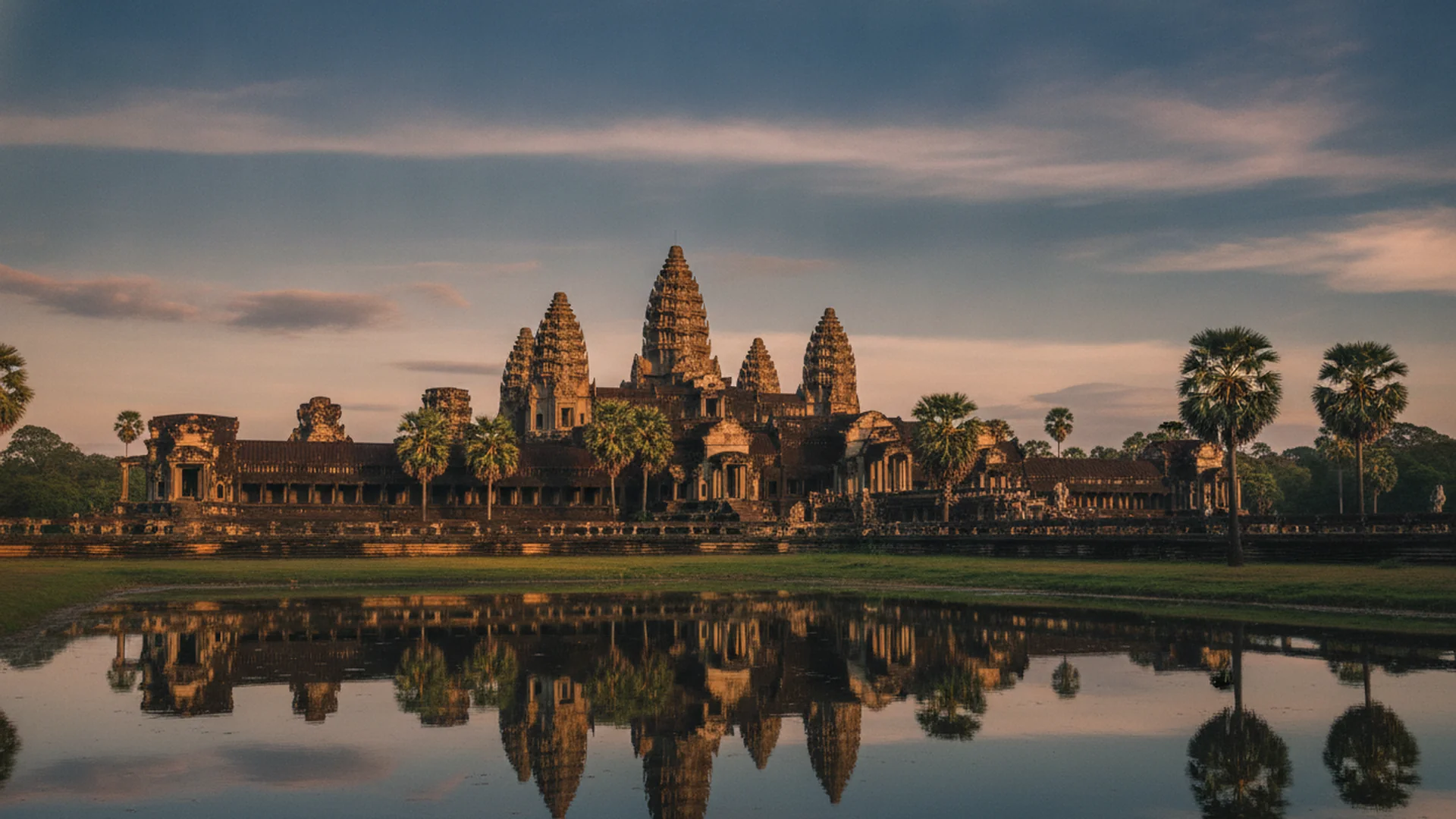
Angkor Wat stands at the centre of Siem Reap's identity as a travel destination. Built between 1113 and 1150 CE by Khmer King Suryavarman II as a Hindu temple dedicated to Vishnu, it covers 162.6 hectares and remains the world's largest religious monument. Five sandstone towers rise 65 metres above the surrounding jungle, representing the peaks of Mount Meru, while a 200-metre-wide moat encircles the complex along a perimeter of more than 5 km. Over 1,200 square metres of continuous bas-relief carvings line the walls, including more than 2,000 individually carved apsara figures, no two alike.
The wider Angkor Archaeological Park, designated a UNESCO World Heritage Site in 1992, stretches across approximately 400 km² and contains more than 1,000 temples and structures built during successive Khmer Empire capitals from the 9th to the 15th century. Key sites beyond Angkor Wat include the Bayon, known for its stone face sculptures, Ta Prohm, and Preah Khan. The APSARA National Authority has managed the park since 1995, working alongside the UNESCO-backed ICC-Angkor committee co-chaired by France and Japan. Conservation efforts were significant enough that Angkor was removed from UNESCO's World Heritage in Danger list in 2004, twelve years after inscription.
Siem Reap city sits approximately 5.5 to 7 km from Angkor Wat and serves as the practical base for visiting the park. The region received nearly 800,000 international visitors in 2023, generating USD 37.1 million in ticket revenues — well below the pre-pandemic peak of 2.6 million visitors recorded in 2018. A new international airport, Siem Reap–Angkor International Airport (SAI), began commercial operations in late 2023, increasing direct flight capacity from regional hubs including Bangkok, Kuala Lumpur, Singapore, and Ho Chi Minh City. Outside the temples, Siem Reap offers Tonlé Sap — Southeast Asia's largest freshwater lake — along with the Angkor National Museum, Pub Street, and the Cambodia Landmine Museum.
Key facts & good to know
How do you travel to Siem Reap and transfer from SAI airport?
Siem Reap-Angkor International Airport (SAI) sits 45 km from the city center, roughly a 60-minute drive. Transfer options include airport shuttle buses, fixed-rate taxis, and DMC private cars. Entry requires either a Cambodia e-Visa or a Visa-on-Arrival.
SAI began commercial operations in late 2023, replacing the older airport closer to town. The 45 km road distance between the terminal and central Siem Reap means transfers average 60 minutes under normal traffic conditions. Fixed-rate taxis and DMC private cars are bookable in the arrivals hall; both follow a set tariff structure rather than metered fares. Airport shuttle buses operate on a shared-seat model and take longer due to drop-off routing across multiple hotels.
Cambodia accepts e-Visas purchased through the official government portal before departure, which avoids queuing at the Visa-on-Arrival counter. Visa-on-Arrival is available for most nationalities but requires a passport photo, the applicable fee in USD, and completion of a paper form at the immigration desk. Processing time at the counter varies with flight volumes; e-Visa holders typically clear immigration faster. Ensure your passport has at least six months of validity remaining from your intended entry date.
SAI is 45 km from central Siem Reap — significantly farther than the former airport. Do not accept unlicensed transport touts inside or outside the terminal. Pre-book your transfer or use the official fixed-rate taxi counter in arrivals. Allow at least 90 minutes for the return journey during peak departure periods, and reconfirm your driver's contact details in case of road delays.
Plan a Siem Reap trip
Where to stay, when to go, and how to combine the highlights of Siem Reap into a paced stopover.
Which months have the lowest rain and temperatures in Siem Reap?
November to February is the cool dry season, with daytime temperatures of 21°C–35°C, lower humidity, and minimal rainfall. The wet season runs May to October, bringing higher humidity and afternoon showers that raise Tonle Sap water levels and affect boat access to floating villages.
The November-to-February window offers the most comfortable touring conditions: temperatures stay within 21°C–35°C during the day, skies are generally clear, and humidity is at its seasonal low. These conditions make early morning sunrise visits to Angkor Wat manageable before midday heat builds. March and April push daytime temperatures to 37°C–40°C, with April being the most intense month; visitors touring in this period should plan temple walks before 9:00 am and after 4:00 pm.
The wet season (May–October) delivers typical Southeast Asian monsoon patterns: mornings are often clear, with heavy afternoon downpours that usually pass within one to two hours. Rainfall during this period raises the water level of Tonle Sap Lake — Southeast Asia's largest freshwater lake — which expands significantly in flood season, altering boat draft requirements for village excursions. At Angkor Wat, the 200-metre-wide moat fills to a higher level and reflects the towers more clearly during wet months, though muddy paths around smaller temples can complicate access. Visitor numbers drop and accommodation rates are lower during this season.
Siem Reap Seasonal Weather Comparison
| Season | Months | Avg Daytime Temp (°C) | Conditions | Crowd Level | Angkor Moat / Tonle Sap Impact |
|---|---|---|---|---|---|
| Cool Dry | Nov–Feb | 21–35 | Low humidity, clear skies | High | Moat at normal level; Tonle Sap at low-water stage, some channels shallow |
| Hot Dry | Mar–May | 37–40 (peak Apr) | Low rain, intense heat | Moderate | Moat level stable; Tonle Sap begins rising from May |
| Wet / Monsoon | May–Oct | 28–35 | Afternoon showers, high humidity | Low | Moat fills fully; Tonle Sap expands, raising boat draft requirements for village access |
Temperature ranges sourced from provided destination facts. Tonle Sap seasonal dynamics affect which floating-village routes are navigable; confirm boat access with operators before booking wet-season excursions.
How many days are needed to tour the Angkor temple circuits?
A 1-day pass covers the 17 km Small Circuit (Angkor Wat, Ta Prohm, Bayon). A 3-day pass allows the 26 km Grand Circuit, adding Preah Khan and Neak Pean. Outer sites like Banteay Srei (35 km) and Koh Ker (120 km) require additional half- or full-day excursions.
The Small Circuit at approximately 17 km connects the three most-visited structures: Angkor Wat, the Bayon with its stone face sculptures, and Ta Prohm. By tuk-tuk (typically USD 15–20 per day), a driver can complete this loop with reasonable time at each site within one full day if you start at 5:00 am for the Angkor Wat sunrise opening. Private cars cover the same circuit faster but cost more. One day is tight; two days on this circuit is more comfortable if you intend to visit the upper sanctuary at Angkor Wat, which requires the dress code and involves a steep climb.
The Grand Circuit extends to approximately 26 km and adds Preah Khan and Neak Pean, among other structures within the park's roughly 400 km² boundary. This routing suits a 2- or 3-day pass. Banteay Srei, known for its detailed pink sandstone carvings, sits 35 km from the city center — a half-day addition by tuk-tuk or car. Koh Ker, a remote temple group 120 km from Siem Reap, requires a full day and a private car or organized tour given the road distance; it falls outside the standard Angkor Pass zone and has separate entry logistics.
Angkor Temple Circuit Routing — Distances and Pass Validity
| Circuit / Site | Distance from City Center (km) | Approx Drive Time from City | Suggested Pass | Key Structures |
|---|---|---|---|---|
| Small Circuit | 5.5–7 km to Angkor Wat gate | 15–20 min | 1-day pass | Angkor Wat, Bayon, Ta Prohm |
| Grand Circuit | 5.5–12 km (varies by temple) | 15–30 min | 3-day pass | Preah Khan, Neak Pean, Preah Neak Poan |
| Banteay Srei | 35 km | 45–60 min | 3-day or 7-day pass | Pink sandstone temple, fine relief carvings |
| Koh Ker | 120 km | 2–2.5 hours | Separate entry (outside Angkor Pass zone) | Remote pyramid-style temple group |
Drive times are approximate and depend on vehicle type and road conditions. Koh Ker requires separate entry arrangements beyond the standard Angkor Pass.
What are the Angkor Pass prices and official entry rules?
Angkor Pass costs USD 37 for 1 day, USD 62 for 3 days, and USD 72 for 7 days. Passes are purchasable via the official e-ticket portal or the physical ticketing center on Apsara Road. Covered shoulders and knees are required to enter the upper sanctuary.
The three pass tiers — 1-day at USD 37, 3-day at USD 62, and 7-day at USD 72 — are sold through the APSARA Authority's official e-ticket portal online or in person at the ticketing center on Apsara Road. The physical center is located before the main entrance checkpoints, so passes must be obtained before attempting to enter any temple. Tickets include a photo taken at purchase, printed on the pass itself, and staff at temple entrances check photo ID against the pass. Tickets are non-transferable.
The APSARA Authority enforces a strict dress code at the upper sanctuary of Angkor Wat (the Bakan tower): shoulders and knees must be covered. On-site staff turn away visitors who do not meet the standard; this is consistently enforced regardless of nationality or time of day. Lightweight long trousers and a sleeved shirt or scarf are the practical solution. The park's general hours run 7:30 am–5:30 pm daily, but Angkor Wat opens at 5:00 am specifically for sunrise access.
Midday temperatures at the temples regularly reach 35°C–40°C between March and May. The stone surfaces and open causeways at Angkor Wat offer little shade. Bring a minimum of 1.5 litres of water per person, apply sunscreen before entering, and schedule upper-sanctuary climbs before 10:00 am or after 3:30 pm. The dress code (covered shoulders and knees) is non-negotiable at the Bakan tower — lightweight, breathable long clothing is the practical solution, not an inconvenience.
Which Siem Reap neighborhoods hold the primary hotel zones?
Three main accommodation zones serve different visitor types: the French Quarter and Old Market area for immediate access to Pub Street dining; Wat Bo across the river for a quieter mixed-budget environment; and Charles de Gaulle Boulevard for large group resorts on the road toward the temple complex.
The French Quarter and Old Market neighborhood sits at the commercial center of Siem Reap, within walking distance of Pub Street and the night market. Hotels here range from guesthouses to mid-scale properties; the trade-off is noise from the entertainment district, which operates late. This zone suits visitors who want to eat, shop, and return to their room on foot without needing transport.
Wat Bo, located across the Siem Reap River from the Old Market, is a lower-density residential-mixed neighborhood with a range of budget guesthouses and smaller boutique properties. It is quieter in the evenings while remaining a short tuk-tuk ride (roughly USD 2–3) from central dining. Charles de Gaulle Boulevard runs north from the city toward the Angkor complex and hosts several larger resort properties set back from the road; these suit group tours that prioritize proximity to the temples over proximity to the town center. Across all zones, USD is the standard transactional currency for hotels, tours, and most restaurants; Khmer Riel (KHR) circulates as small change, and vendors typically price in USD.
What excursions and day trips operate outside the temple complex?
Regional excursions from Siem Reap include Tonle Sap lake villages (15 km to Chong Kneas, 30 km to Kampong Phluk), Phare Cambodian Circus performances in town, and Kulen Mountain 50 km away. Kampong Phluk is only accessible during wet-season high water; Chong Kneas operates year-round.
Tonle Sap, Southeast Asia's largest freshwater lake, is accessible from two main departure points. Chong Kneas is 15 km from Siem Reap and operates year-round, making it the default option for most day-trip itineraries. Kampong Phluk, at 30 km, is a stilted-house village that is only reachable by boat when water levels are high enough — typically July through November. During the dry season, the water recedes and the channels are too shallow for boat navigation to Kampong Phluk. Visitors should confirm access with operators before booking, particularly between December and May.
Phare, The Cambodian Circus, performs in a dedicated tent venue in Siem Reap town. Shows run on a fixed weekly schedule with multiple seating tiers at different price points; advance booking is recommended during the November-to-February high season when performances sell out. Kulen Mountain sits 50 km from Siem Reap — the same sandstone source used to build Angkor Wat — and is reachable by private car in approximately 60–75 minutes. The mountain requires a separate entry permit outside the Angkor Pass. The road involves some unpaved sections, so motorcycle-based transport is not advisable.
Kampong Phluk is inaccessible by boat during the dry season (approximately December–June) when water levels are too low. Do not book this excursion without confirming current water conditions with a licensed operator. At Chong Kneas, some independent boat operators charge inflated fees and route visitors to commercial floating shops under the guise of a village tour. Use a verified DMC or tour operator and confirm the itinerary includes actual community access, not only retail stops.
Siem Reap attractions & tickets
Pre-purchased entrance tickets, private transfers and certified guides — no queues, no logistics hassle.
Building a siem-reap itinerary for your clients?
Send us your dates and pace — we return a realistic, booked-and-paced plan with net rates, not a generic template.
Want this tailored to your dates?
We run these routes ourselves. Send your dates, group size and pace and our Hanoi team will build a custom version — with real prices, not estimates.
Frequently asked questions
People also ask
Verified sources
- ATL DMC booking log · 12,000+ trips since 2011
- UNESCO – 28th Anniversary of Angkor on the World Heritage List · https://www.unesco.org/en/articles/28th-anniversary-angkor-unesco-world-heritage-list
- Wikipedia – Angkor Wat · https://en.wikipedia.org/wiki/Angkor_Wat
- World History Encyclopedia – Angkor Wat · https://www.worldhistory.org/Angkor_Wat/
Turn this guide into a trip
The products we actually run for this route — book direct, no OTA markup.
Plan your custom trip with Phuong Le
Phuong Le
“Tell us your dates and pace — we'll turn this guide into a realistic, booked-and-paced trip for you, not a generic template.”
Plan my trip with our team →About the authors
Phuong Le · primary author
Specialty: Hanoi · Halong Bay · Vietnam itineraries.
Cross-category lattice
Plan your trip
Practical
Related travel guides
1× per month · pillar guides + new itineraries
Get our newest pillar guides + quarterly itinerary updates delivered. No spam, no promotions, just travel-guide content. Unsubscribe anytime.