Quick answer
Start at Hoan Kiem; walk 1.5–2 km (15–20 min) to Long Bien Bridge. Sunset window: 5:15–6:30 pm (Nov–Feb), 5:45–7:00 pm (Mar–Oct). Stay on the ped lane; mind trains. Market below peaks 10 pm–3 am. Stairs near Long Bien Station lead to Banana Island paths.
Why this guide
About this guide
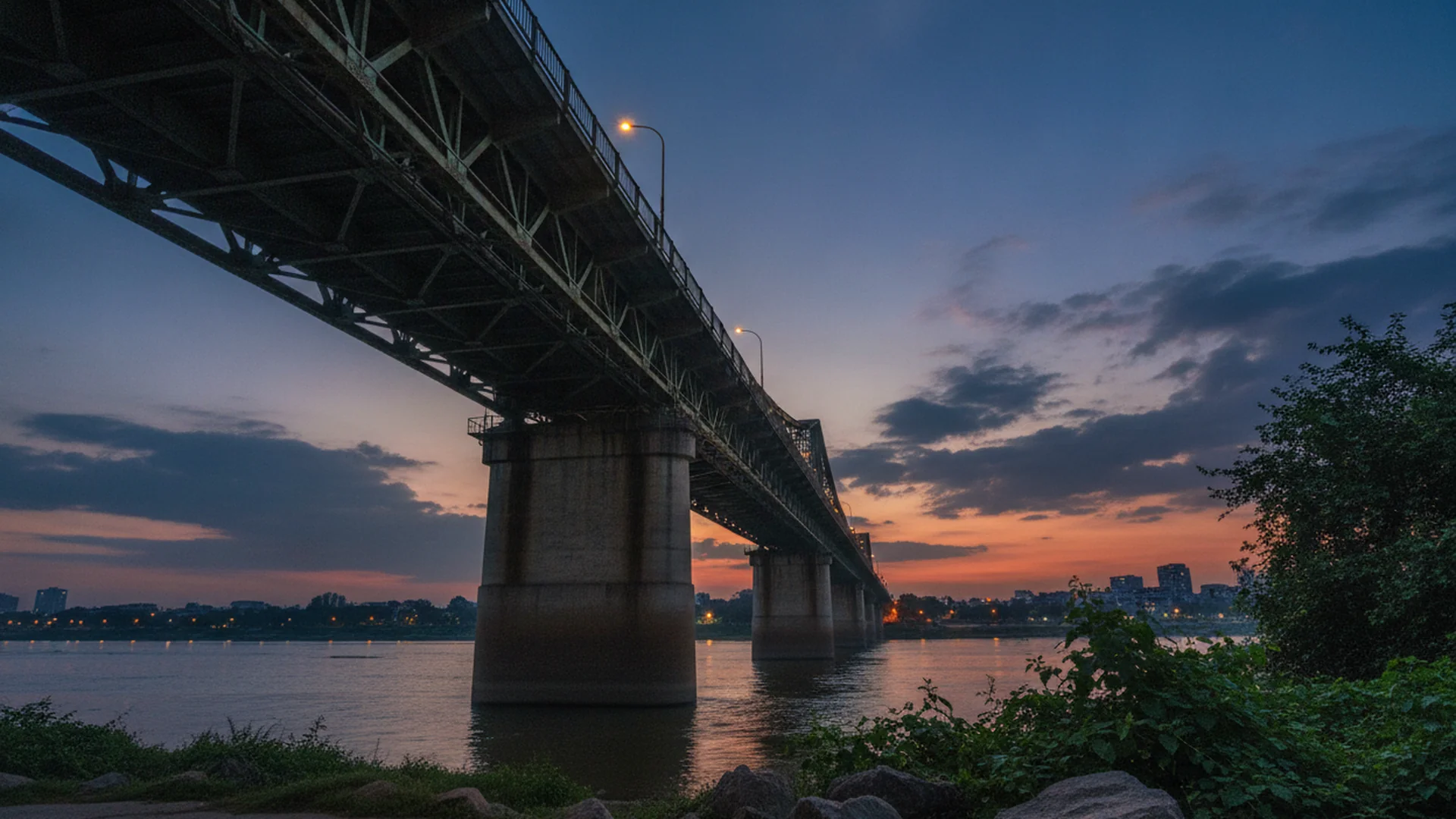
Long Biên Bridge crosses the Red River between Hoàn Kiếm and Long Biên districts, stretching 2.4 kilometres on a cantilever frame built between 1899 and 1902 by the Parisian firm Daydé & Pillé. When it opened in 1903, it ranked among the longest bridges in Asia. Construction required over 3,000 Vietnamese workers and 5,600 tons of rolled steel, producing an ornate lattice ironwork structure that locals and visitors sometimes call 'the horizontal Eiffel Tower in Hanoi.'
The bridge's wartime history is visible in its current form. As the only Red River crossing connecting Hanoi to the port of Haiphong, it was a sustained bombing target during the Vietnam War. Only six of the original nineteen arches remain intact today, and just one third of the bridge's current components are original material. That patchwork of repair and replacement is part of what makes the structure a tangible record of the city's mid-20th-century experience rather than a restored showpiece.
A smaller afternoon market operates directly on the bridge deck, where residents of Ngoc Thuy village buy fresh vegetables and fish for dinner — a daily practice that has continued for generations. Below the bridge on Yen Phu Street, Long Biên Market runs every night from 10 PM until dawn, peaking between 2 AM and 4 AM when trucks carrying seafood from Halong and Haiphong unload under floodlights. A mid-bridge ramp descends to Bãi Giữa, a Red River sandbar of banana plantations and vegetable plots. The bridge itself is free and open around the clock, served by city bus routes 01, 14, 15, 22, 34, 47, and 55.
Key facts & good to know
How do you access the Long Bien Bridge pedestrian path, and what is the physical difficulty?
Enter via the ramp near Long Bien Railway Station. The bridge spans 2.29 km and takes 45–60 minutes to walk. Pedestrians use the outer 1-metre edge beside scooter lanes. Expect uneven concrete, stairs, and open-air wind exposure.
The pedestrian access ramp sits adjacent to Long Bien Railway Station at the Hoan Kiem end of the bridge. Tour operators arriving by 16-seater van typically drop groups on Tran Nhat Duat street, where passengers walk a short distance to the ramp entrance. The bridge carries three distinct traffic streams: a live rail track runs down the centre, scooters occupy the inner lanes on both sides, and pedestrians are confined to the outer 1-metre-wide edge strips.
The 2.29 km span takes most walkers between 45 and 60 minutes at a relaxed pace, though stops for photography or to watch trains extend that considerably. Physically, the route is low-intensity but demands attention: concrete slabs are uneven and in places cracked or sunken, several staircase sections connect different deck levels, and the open ironwork structure offers no shelter from wind, which can be significant in winter months. Anyone with a fear of heights or unsteady footing should be aware that the outer walkway has minimal guardrail height in sections.
Plan a Hanoi trip
Where to stay, when to go, and how to combine the highlights of Hanoi into a paced stopover.
What time do trains cross the bridge, and where are the best sunset observation points?
Trains from Hai Phong and Yen Bai cross in the afternoon and evening; exact crossing times vary by schedule. Mid-span alcoves offer the clearest sightlines over the Red River at sunset, though bridge vibration limits tripod use.
Trains running the Hanoi–Hai Phong and Hanoi–Yen Bai lines cross Long Bien Bridge several times daily, including afternoon and early evening departures and arrivals. The centre rail track is live, so a train's approach is audible and visible well in advance. The recommended strategy for photographers is to position at one of the mid-span alcoves — shallow recesses in the outer walkway where the bridge structure widens slightly — which place you out of the scooter lane and give an unobstructed view down the Red River toward the setting sun.
Tripod photography on the bridge is compromised by vibration. When a loaded train passes or heavy scooter traffic builds, the deck transmits enough movement to blur long exposures. Photographers who need stable shots often descend to the base of the bridge near Banana Island, where the ironwork arches frame the river without the vibration problem, though the elevation and sightline differ significantly from the mid-span position.
Comparison of sunset photo locations: bridge alcoves vs. Banana Island base
| Location | Elevation above river | River sightline | Vibration level | Passing traffic exposure |
|---|---|---|---|---|
| Mid-span bridge alcoves | ~15–17 m (approx.) | Direct, wide downstream view | High when trains or heavy scooter traffic pass | Scooters on adjacent lane; trains on centre track |
| Banana Island base (Bai Giua) | At river level | Arches frame the view; upward angle | Negligible | Foot traffic only; no vehicles |
Elevation figures are approximate; exact clearance varies by river level and season. Vibration at mid-span is most pronounced during train crossings.
When does the Long Bien wholesale market operate, and what are the logistics for tour groups?
The market under the bridge arches on Yen Phu Street runs nightly from around 22:00 until dawn, with peak wholesale activity between 02:00 and 04:00. Group sizes should be capped at 4–6 people due to heavy handcart traffic and confined, slippery floors.
Long Bien Market sets up from approximately 22:00 each night as vendors arrange goods and early trucks begin arriving. By 02:00 the space under the bridge arches is at full intensity: trucks from northern Vietnam, carrying seafood from Halong Bay and Haiphong alongside produce from the northern highlands, unload under floodlights while handcart operators move goods at speed through narrow lanes. Trading clears progressively from around 04:00, and the area is largely dispersed by 06:00.
For operators bringing clients, the physical environment dictates small groups. Floors are wet and slippery from seafood and produce runoff, and loaded handcarts move quickly with limited warning. Groups larger than 4–6 people become difficult to manage safely in the confined lanes, and the noise level makes verbal communication unreliable. This is a working B2B wholesale market, not a retail space: clients should expect to observe rather than browse, and should dress for cold, damp conditions in the cooler months.
Long Bien night wholesale market vs. Dong Xuan daytime market
| Feature | Long Bien Wholesale Market | Dong Xuan Market |
|---|---|---|
| Operating hours | ~22:00 to 06:00 (peak 02:00–04:00) | Daytime (approximately 06:00–18:00) |
| Primary buyer | Wholesale traders, restaurant suppliers | Retail shoppers, tourists |
| Main goods | Seafood, fresh produce, flowers | Clothing, household goods, dry goods, some food |
| Walkability for tourists | Difficult; wet floors, fast handcarts, confined lanes | Moderate; crowded but navigable |
| Recommended group size | 4–6 maximum | Flexible; larger groups manageable |
| Location | Under bridge arches, Yen Phu Street | Enclosed building, Dong Xuan Street, Hoan Kiem |
Hours are operational norms reported by market traders and DMC operators; they can vary by season and public holidays.
What are the safety hazards and restricted activities on the bridge?
Key hazards include degraded footboards, occasional missing panels, proximity to moving scooter traffic, and pickpocket risk during busy periods. Drone flight is strictly prohibited over Hanoi infrastructure and military zones. Walk single-file on the outer pedestrian edge.
The bridge deck shows visible structural deterioration in sections: footboards are rusted, some panels have gaps or are missing entirely, and the surface is uneven throughout. The outer pedestrian walkway is narrow enough that two people walking side-by-side leave little margin if a scooter drifts. Single-file walking is the standard practice and should be enforced by guides with groups. The proximity to active scooter traffic — which uses the adjacent inner lane with no physical barrier in most sections — is the primary injury risk.
Only six of the original nineteen arches survive from the bridge's 1903 construction, and approximately two-thirds of the current structure consists of replacement pieces installed after wartime bombing damage. This history of repair means the structural integrity varies across different sections of the span. Visitors should avoid leaning heavily on railings or sitting on the outer edge.
Drone flight is strictly prohibited over Long Bien Bridge and the surrounding Red River corridor; the area falls within Hanoi's infrastructure and military restricted zones, and violations carry serious legal penalties. During peak sunset hours and at the night market below, pickpocketing is an active risk — clients should keep bags zipped, phones in front pockets, and valuables out of view. Guides should conduct a pre-walk briefing on single-file movement, gap awareness in the deck surface, and the prohibition on sitting on outer railings or edge structures.
How do you access the Banana Island agricultural trails from the bridge?
A mid-bridge iron staircase descends to Bai Giua (Banana Island), a Red River sandbar with banana plantations and vegetable plots. Paths are dirt and unfacilitated. Flooding during peak monsoon months (July–August) makes the trails inaccessible. Closed-toe shoes, insect repellent, and water are required.
Roughly at the midpoint of the bridge span, an iron staircase on the downstream side descends from the deck level to the sandbar below, known as Bai Giua or Banana Island. The transition from the bridge's concrete and steel environment to the island's dirt paths and active cultivation is abrupt. The island supports working banana plantations, vegetable plots, and during cooler months, seasonal flower gardens. There are no facilities of any kind on the island — no toilets, no food vendors, and no shade structures.
The Red River's water level rises substantially during the monsoon season, and the island's low-lying paths flood during peak flow in July and August, making access inadvisable or impossible in those months. Outside of monsoon season the terrain is passable but uneven, with soft soil in places after rain. Required gear for the descent includes closed-toe shoes with grip — sandals are unsuitable — along with DEET-based insect repellent for mosquitoes active at dusk, and sufficient drinking water for the duration of the visit given the absence of any resupply point on the island.
Hanoi attractions & tickets
Pre-purchased entrance tickets, private transfers and certified guides — no queues, no logistics hassle.
Building a hanoi itinerary for your clients?
Send us your dates and pace — we return a realistic, booked-and-paced plan with net rates, not a generic template.
Want this tailored to your dates?
We run these routes ourselves. Send your dates, group size and pace and our Hanoi team will build a custom version — with real prices, not estimates.
Frequently asked questions
People also ask
Verified sources
- ATL DMC booking log
- Long Biên Bridge – Wikipedia · https://en.wikipedia.org/wiki/Long_Bi%C3%AAn_Bridge
- Long Bien Bridge – Vietnam National Administration of Tourism (vietnamtourism.gov.vn) · https://vietnamtourism.gov.vn/en/post/15507
- Long Bien Bridge – Vietnam Airlines Travel Guide · https://www.vietnamairlines.com/us/en/plan-book/travel/travel-guide/long-bien-bridge
- Long Bien Market Hanoi – VinWonders · https://vinwonders.com/en/wonderpedia/news/long-bien-market-hanoi/
- Long Bien Market – Vietnam Online (vietnamonline.com) · https://www.vietnamonline.com/attraction/long-bien-market.html
- Long Bien Bridge: A True Icon of Hanoi – Authentik Travel · https://authentiktravel.com/the-long-bien-bridge-a-true-icon-of-hanoi
- Long Bien Bridge – Your Vietnam Travel · https://www.yourvietnamtravel.com/long-bien-bridge
Turn this guide into a trip
The products we actually run for this route — book direct, no OTA markup.
Plan your custom trip with Phuong Le
Phuong Le
“Tell us your dates and pace — we'll turn this guide into a realistic, booked-and-paced trip for you, not a generic template.”
Plan my trip with our team →About the authors
Phuong Le · primary author
Specialty: Hanoi · Halong Bay · Vietnam itineraries.
Cross-category lattice
Plan your trip
Practical
Related travel guides
1× per month · pillar guides + new itineraries
Get our newest pillar guides + quarterly itinerary updates delivered. No spam, no promotions, just travel-guide content. Unsubscribe anytime.