Quick answer
Quick Da Nang travel guide: Go Feb–May; Sep–Nov is wet. Beaches: My Khe, Non Nuoc. Dragon Bridge fires Sat–Sun 9pm. Day trips: Hoi An (30km), Ba Na Hills, Marble Mountains, Son Tra. Get around by Grab or 150k–200k VND/day motorbike. Eats: mi quang, banh xeo (30k–60k).
Why this guide
About this guide
Da Nang sits on Vietnam's central coast, where a 10-kilometre arc of sand known as My Khe Beach runs from the foot of Son Tra Peninsula south to the Marble Mountains. Forbes magazine listed it among the world's six most beautiful beaches. Surfers target My An and Non Nuoc beaches between November and March when wave conditions are strongest, while the February-to-May window brings warm weather, low rainfall, and calmer water suited to swimming. Non Nuoc Beach, at 5 km long and positioned directly below the Marble Mountains, draws considerably fewer visitors than the main My Khe stretch.
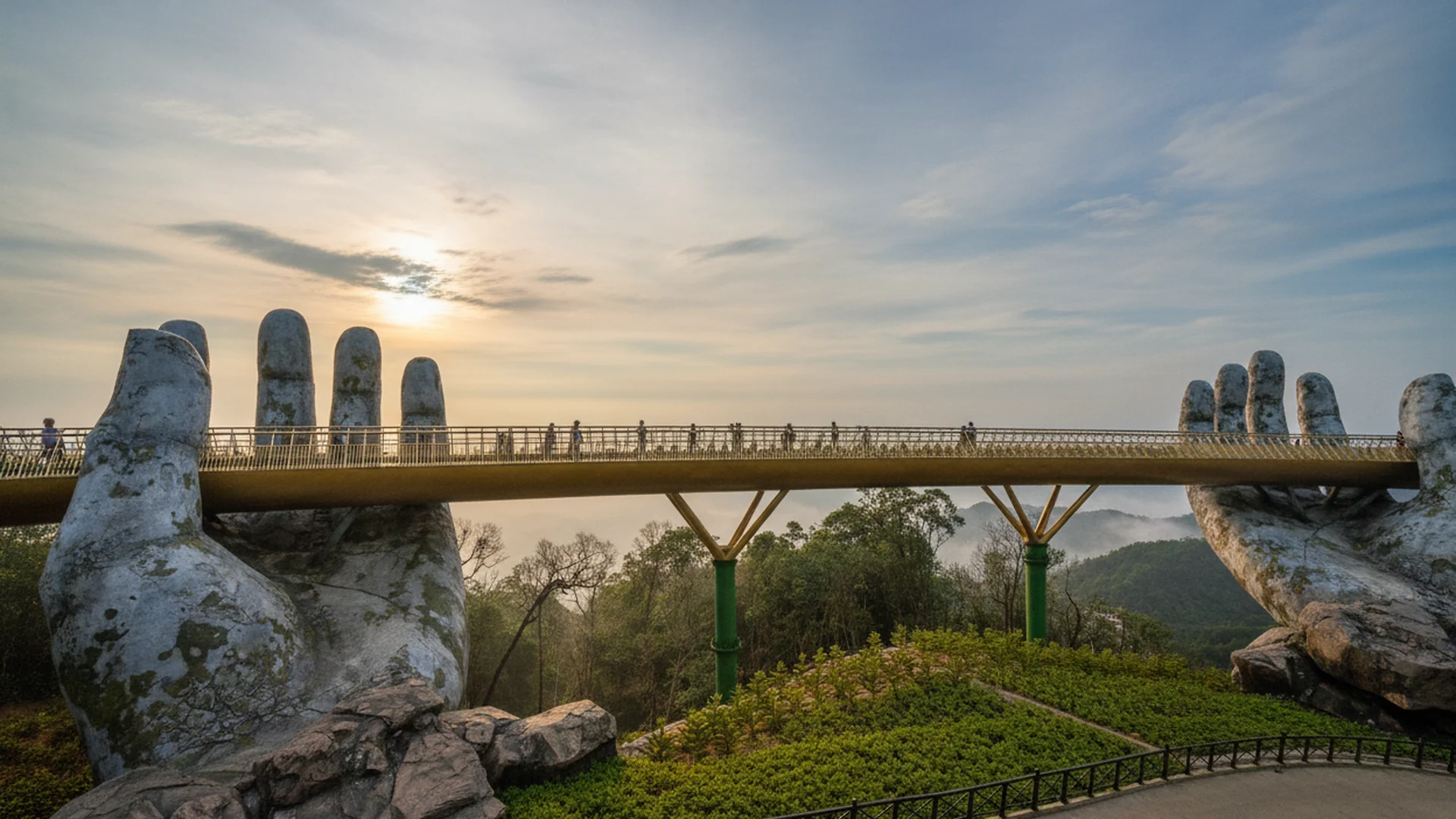
Two bridges define Da Nang's skyline in markedly different ways. The Dragon Bridge spans 666 metres across the Han River — 37.5 metres wide with six traffic lanes — making it the largest dragon-shaped steel bridge in the world. Inaugurated on 29 March 2013 to mark the 38th anniversary of Da Nang's liberation, the structure is lit each night by over 2,500 LED lights, with a fire-breathing and water-spraying display every Saturday and Sunday at 9 PM that is free to attend. Forty kilometres west of the city at 1,414 metres elevation inside Ba Na Hills, the Golden Bridge (Cầu Vàng) offers a very different experience: a 150-metre pedestrian walkway appearing to rest in two giant stone hands above the clouds. Reachable only by a cable car route exceeding 5 km — among the longest in the world — it opened in 2018 and is roughly 10°C cooler than the city below.
Da Nang's geographic position places several significant historical sites within easy reach. The Marble Mountains — five limestone and marble hills named after the five elements — lie just 8 km southeast of the city centre and contain caves, Buddhist shrines, and coastal viewpoints. Hoi An Ancient Town, a UNESCO World Heritage Site inscribed in 1999 for its well-preserved trading port character dating from the 15th to 19th centuries, is roughly 45 minutes south and recorded over 4.42 million visitors in 2024. Hue Imperial City, the seat of 13 Nguyen Dynasty emperors from 1802 to 1945 and also UNESCO-listed, sits approximately two hours north via the Hai Van Pass. My Son Sanctuary, about 40 km from Da Nang, preserves Hindu temple ruins constructed by the Champa civilisation between the 4th and 13th centuries and carries its own UNESCO designation.
Key facts & good to know
Why choose Da Nang as a base for Central Vietnam travel?
Da Nang sits within 45 minutes of Hoi An, two hours of Hue, and 40 km of My Son, while its international airport (DAD) places travelers in the city center or on a beach within 10 minutes of landing.
Da Nang International Airport (DAD) is unusually close to both the urban core and the main beach strip, meaning a taxi or Grab car reaches My Khe Beach or the Han River hotel zone in roughly 10 minutes. That short transfer reduces the dead time that typically eats into short itineraries, making the city workable even for three-night stops.
The city's road connections give it genuine range. Hoi An Ancient Town lies about 30 km south — a 45-minute ride — while Hue is approximately 100 km north via the Hai Van Pass, covered in around two hours. My Son Sanctuary sits roughly 40 km to the southwest, accessible in under an hour. That triangle means a traveler can base in one place and visit three UNESCO World Heritage Sites without relocating.
Different traveler types find different parts of the city useful. Families tend to anchor in large resort compounds along Non Nuoc Beach near the Marble Mountains. Remote workers cluster in An Thuong, a walkable neighborhood behind My Khe with dense café coverage and short-term rental apartments. Transit-focused visitors use Hai Chau district, close to the airport and the river, as a launching pad for day tours rather than a beach destination in itself.
Plan a Da Nang trip
Where to stay, when to go, and how to combine the highlights of Da Nang into a paced stopover.
Which months offer dry weather and calm seas in Da Nang?
The dry season runs February through August, with temperatures between 25°C and 35°C. Calm, swimmer-friendly seas occur April to July. October to December brings surf swells and the highest rainfall.
February to May is the period most consistently cited for beach use — warm air temperatures sit in the 25°C–30°C range, rainfall is minimal, and ocean surface conditions are calm enough for swimming and paddling. By June and July, temperatures push toward 35°C and humidity rises, but seas remain largely flat. Those months work for beach-focused travel provided visitors plan outdoor activity in the early morning or late afternoon.
The transition into the rainy season begins in September. By October, northeast monsoon swells reach the coast, and surf breaks at My An and Non Nuoc become active. November through March sees the highest swell consistency and the lowest air temperatures — averaging around 25°C or below — which makes the beaches less comfortable for leisure swimming but draws surfers. Typhoon risk is real between September and November; itineraries built around that window need contingency days.
January sits in the middle of the cool, wet season. Rain events can last several days continuously, and ocean conditions are typically rough. Travelers arriving for Tet (late January or February, depending on the lunar calendar) often find better weather by the second half of February as the dry season establishes itself.
Da Nang Monthly Conditions by Season
| Period | Approx. Temp Range | Rainfall Pattern | Ocean Conditions | Primary Use |
|---|---|---|---|---|
| February–March | 25°C–28°C | Low | Calm, improving | Beach swimming, city tours |
| April–May | 28°C–32°C | Very low | Calm | Beach swimming, day trips |
| June–August | 32°C–35°C | Low–moderate | Calm | Beach, Ba Na Hills escape |
| September | 28°C–32°C | Increasing | Choppy, variable | City sightseeing, flexible |
| October–December | 22°C–28°C | High, typhoon risk | Surf swells active | Surfing, indoor sites |
| January | 20°C–25°C | Moderate–high | Rough | Hue/Hoi An day trips |
Temperature ranges are approximate averages. Ocean conditions vary by beach exposure and storm track; always check local forecasts before entering the water.
Da Nang falls within Vietnam's typhoon corridor. Between September and November, tropical storms can make landfall with little notice, causing beach closures, road flooding on the Hai Van Pass, and suspension of Ba Na Hills cable car operations. Book refundable or reschedulable transport and accommodation during this window, and monitor the Vietnam National Centre for Hydro-Meteorological Forecasting (nchmf.gov.vn) daily.
Where are the primary swimming beaches in Da Nang and what are the water conditions?
My Khe is the main public beach — 10 km long with showers and high foot traffic. Non Nuoc, 5 km long near the Marble Mountains, is quieter and resort-adjacent. Son Tra coves are rocky and sheltered but not set up for large crowds.
My Khe runs for 10 km from the base of the Son Tra Peninsula down toward the Marble Mountains. Public shower and changing facilities are available at intervals along the strip, and the beach handles significant foot traffic, particularly on weekends when local families join tourists. Designated swimming zones are marked by flag systems: green flags indicate safe conditions, yellow flags call for caution, and red flags mean the water is closed to swimmers. Lifeguard coverage operates during daytime hours in the peak season, though hours and coverage points should be confirmed locally each visit.
Non Nuoc Beach occupies 5 km at the foot of the Marble Mountains and draws a quieter crowd, partly because access runs through or alongside resort compounds. The absence of a dense strip of street-food vendors and rental shops means foot traffic is lower. Ocean exposure is similar to My Khe but the built environment feels more contained. Surfers use My An and Non Nuoc during the November-to-March swell window, when waves are inconsistent with safe swimming conditions.
Jellyfish presence at Da Nang beaches is a documented seasonal occurrence, most commonly reported in the warmer months between May and August. Stings are generally minor but can be painful. The Son Tra Peninsula has small, rocky coves that offer shelter from open-ocean swells, but there are no formal facilities — no lifeguards, no flag systems, and limited access by road. They suit experienced swimmers looking for quieter water, not families with children.
Da Nang Beach Comparison
| Beach | Length | Crowd Level | Facilities | Surf Season Active | Notes |
|---|---|---|---|---|---|
| My Khe | 10 km | High | Public showers, flag zones, lifeguards (seasonal) | Nov–Mar (avoid swimming) | Main public beach; Forbes-listed stretch |
| Non Nuoc | 5 km | Low–moderate | Resort facilities, limited public access points | Nov–Mar (surfing zone) | Adjacent to Marble Mountains |
| Son Tra coves | Varies (small) | Low | None | Sheltered, less affected | Rocky entry; no lifeguard coverage |
Lifeguard hours and flag-zone locations are set by Da Nang City authorities and may change seasonally. Verify current coverage at the beach entrance or with your accommodation.
Da Nang beaches use a color-flag warning system. A red flag means the water is closed to swimmers — this is enforced by lifeguards during staffed hours. Jellyfish stings are reported at My Khe and Non Nuoc between May and August; ask beach staff about current conditions before entering the water. Outside lifeguard hours (typically after 17:00–18:00 in peak season), swimming is unsupervised even in designated zones.
When does the Dragon Bridge operate its fire show and how do you navigate the riverfront?
The Dragon Bridge fire-and-water show runs every Saturday and Sunday at 21:00 and is free to watch. Traffic closures begin approximately 15 minutes before the show. Viewing works from either bank or a river cruise.
The Dragon Bridge spans 666 metres across the Han River with six traffic lanes and is illuminated nightly by over 2,500 LED lights along the dragon's body. The fire-breathing and water-spraying sequence, however, only activates on Saturday and Sunday evenings at 21:00. The show lasts several minutes and draws large riverside crowds. Because the bridge itself is closed to vehicle traffic roughly 15 minutes before the show starts, drivers approaching from either bank need to route around via alternative Han River crossings.
The Han River Bridge, located a short distance upstream, includes a swing span that rotates to allow river traffic through. That swing operation — typically scheduled on weekend nights — can also affect vehicular routing on the western bank. If you are driving or taking a Grab car on a Saturday or Sunday evening, build extra time into your journey and communicate the closure to your driver in advance. The east bank (My Khe side) and the west bank (Hai Chau side) both offer unobstructed sightlines to the dragon head, and neither requires a ticket.
River cruises that time their route to pass under or near the bridge during the 21:00 show are offered by several operators, giving a different viewing angle. Prices and departure points vary by operator. Arriving on the riverfront by 20:30 gives enough time to choose a position before the crowd density peaks; the areas directly opposite the dragon's head on both banks fill earliest.
Vehicle access to the Dragon Bridge is suspended approximately 15 minutes before the Saturday and Sunday 21:00 show. GPS navigation apps may not reflect real-time closure status. If your accommodation or restaurant is on the opposite bank from your starting point, plan an alternative route via a neighboring bridge before 20:30. The Han River Bridge swing schedule can compound delays on the same evenings — confirm current scheduling with your hotel or DMC operator.
What are the travel times and transport options for day trips from Da Nang?
Hoi An takes about 45 minutes by Grab or taxi (30 km south). Ba Na Hills is a 45-minute drive plus a cable car ride of over 5 km. My Son Sanctuary is roughly one hour away at 40 km. Hue is approximately two hours north.
The Marble Mountains are the shortest excursion from the city at just 8 km southeast of the center, reachable in 15–20 minutes by Grab. Hoi An Ancient Town — a UNESCO World Heritage Site inscribed in 1999 — sits about 30 km south and is covered in roughly 45 minutes by Grab car or taxi, making it a practical half-day option. My Son Sanctuary, another UNESCO-listed site about 40 km from Da Nang, contains Champa Hindu temple ruins from the 4th to 13th centuries and takes around one hour by road. Hue Imperial City is the longest run at approximately 100 km north via the Hai Van Pass, which adds scenic time but lengthens the journey to roughly two hours each way.
Ba Na Hills, approximately 40 km west of Da Nang, requires a drive of about 45 minutes to the cable car base station, then a cable car ride of over 5 km — one of the longest cable car routes in the world — before reaching the main complex at 1,414 metres elevation. The temperature at that altitude is approximately 10°C cooler than the city, which is relevant for packing. The Golden Bridge pedestrian walkway (150 metres long) is inside the Ba Na Hills complex and accessible only through it; there is no independent access route.
Transport choice affects both cost and flexibility. Grab cars and Vinasun or Mai Linh metered taxis work well for short runs like the Marble Mountains or Hoi An, but the metered fare to Hue would be high. Pre-booked private DMC drivers offer a fixed price and flexibility to stop at the Hai Van Pass viewpoint en route to Hue — a stop that is difficult to arrange with a Grab booking. Scheduled shuttle buses to Hoi An run regularly and cost less per seat, but they operate on fixed departure times and drop passengers at a set point rather than door to door. For Ba Na Hills, the cable car entry pricing is bundled with site access; verify current rates directly with the operator before booking, as pricing structures have changed periodically.
Day Trip Logistics from Da Nang City Center
| Destination | Distance | Approx. Drive Time | Transport Options | Notable Access Detail |
|---|---|---|---|---|
| Marble Mountains | 8 km SE | 15–20 min | Grab, taxi, scooter | Walk-in entry; elevator available to summit |
| Hoi An Ancient Town | ~30 km S | ~45 min | Grab, taxi, shuttle bus | UNESCO site; cars park at perimeter, walk into old town |
| Ba Na Hills / Golden Bridge | ~40 km W | ~45 min drive + cable car (5 km+) | Private driver, DMC tour | Cable car access only; entry pricing subject to change |
| My Son Sanctuary | ~40 km SW | ~60 min | Private driver, DMC tour, group shuttle | UNESCO Champa ruins; limited public transport |
| Hue Imperial City | ~100 km N | ~2 hrs via Hai Van Pass | Private driver, DMC tour, train | Hai Van Pass viewpoint stop requires pre-arrangement |
| Hai Van Pass (viewpoint only) | ~20 km N to base | ~30 min to lower approach | Private driver, scooter (IDP required) | Road can close in heavy rain or typhoon conditions |
Drive times assume normal traffic conditions. Weekend mornings and public holidays add 10–20 minutes on routes toward Hoi An. Ba Na Hills cable car and entry pricing should be confirmed directly with the Sun World Ba Na Hills operator before travel.
Should you stay near the Han River or the beach, and how do you get around Da Nang?
An Thuong neighborhood sits walkable from My Khe Beach with dense café and apartment options. Non Nuoc suits compound-resort travelers near the Marble Mountains. Hai Chau district offers city-center convenience and proximity to DAD airport.
An Thuong is a compact neighborhood between the My Khe beachfront and the main road running parallel to it. The area has a high concentration of independent cafés, short-term rental apartments, and small hotels, making it functional for remote workers who want beach access without being inside a large resort. Distances to the sand are walkable — typically five to ten minutes on foot. The trade-off is that the nearest major shopping or transport hub requires a Grab ride.
Non Nuoc Beach, 8 km further south near the Marble Mountains, is where the large resort compounds operate. These properties have their own pools, restaurants, and beach access, meaning guests can spend several days without leaving the premises. That isolation works well for families or travelers on short, structured visits, but getting to the city center or the Dragon Bridge requires a 20–30 minute taxi or Grab ride each way. Hai Chau district, Da Nang's commercial and administrative center on the Han River, is the closest zone to the airport and the main departure point for tour buses. It suits travelers prioritizing day-trip logistics over beach proximity.
Within the city, Grab cars are the most practical option for most travelers — the app works reliably, pricing is transparent before booking, and drivers are trackable. Vinasun and Mai Linh run metered taxis and are legitimate alternatives; avoid unmarked or unsolicited taxis near the airport. Scooter rental is widely available and gives the most freedom for self-directed travel, but Vietnamese law requires an International Driving Permit (IDP) endorsed for motorcycles for foreign nationals operating a scooter. Riding without a valid IDP creates legal exposure in the event of an accident, including potential issues with travel insurance claims.
Da Nang Accommodation Zone Comparison
| Zone | Distance to My Khe Beach | Distance to DAD Airport | Distance to City Center (Hai Chau) | Character | Best For |
|---|---|---|---|---|---|
| An Thuong | ~5–10 min walk | ~10–15 min by car | ~10 min by car | Walkable, café-dense, mixed accommodation | Remote workers, independent travelers |
| Non Nuoc / Marble Mountains | On-site (resort beaches) | ~25–30 min by car | ~20–25 min by car | Isolated resort compounds | Families, all-inclusive stays |
| Hai Chau (city center) | ~15–20 min by car | ~10 min by car | Walking distance (central) | Urban, commercial, river views | Business travelers, day-trip base |
Drive times are estimates under normal traffic conditions. An Thuong to city center can extend during morning rush hours on weekdays.
Da Nang attractions & tickets
Pre-purchased entrance tickets, private transfers and certified guides — no queues, no logistics hassle.
Building a da-nang itinerary for your clients?
Send us your dates and pace — we return a realistic, booked-and-paced plan with net rates, not a generic template.
Want this tailored to your dates?
We run these routes ourselves. Send your dates, group size and pace and our Hanoi team will build a custom version — with real prices, not estimates.
Frequently asked questions
People also ask
Verified sources
- ATL DMC booking log · 12,000+ trips since 2011
- Vietnam National Authority of Tourism – Hoi An Conservation · https://vietnamtourism.gov.vn/en/post/21379
- Wikipedia – Dragon Bridge Da Nang · https://en.wikipedia.org/wiki/Dragon_Bridge_(Da_Nang)
- Wikipedia – Hoi An Old Town · https://en.wikipedia.org/wiki/H%E1%BB%99i_An_Old_Town
- Pullman Da Nang – Dragon Bridge History & Design · https://www.pullman-danang.com/discovery/destination/dragon-bridge-history/
- Central Vietnam Guide – Golden Bridge Da Nang · https://centralvietnamguide.com/golden-bridge-da-nang/
- Vietnam Nomad – My Khe Beach Da Nang Local Guide · https://vietnamnomad.com/destinations/central-vietnam/da-nang/my-khe-beach-da-nang/
- Royal Caribbean – Famous Landmarks in Vietnam (Marble Mountains, Golden Bridge) · https://www.royalcaribbean.com/inspire/famous-landmarks-in-vietnam
Turn this guide into a trip
The products we actually run for this route — book direct, no OTA markup.
Plan your custom trip with Phuong Le
Phuong Le
“Tell us your dates and pace — we'll turn this guide into a realistic, booked-and-paced trip for you, not a generic template.”
Plan my trip with our team →About the authors
Phuong Le · primary author
Specialty: Hanoi · Halong Bay · Vietnam itineraries.
Cross-category lattice
Plan your trip
Practical
Related travel guides
1× per month · pillar guides + new itineraries
Get our newest pillar guides + quarterly itinerary updates delivered. No spam, no promotions, just travel-guide content. Unsubscribe anytime.