Quick answer
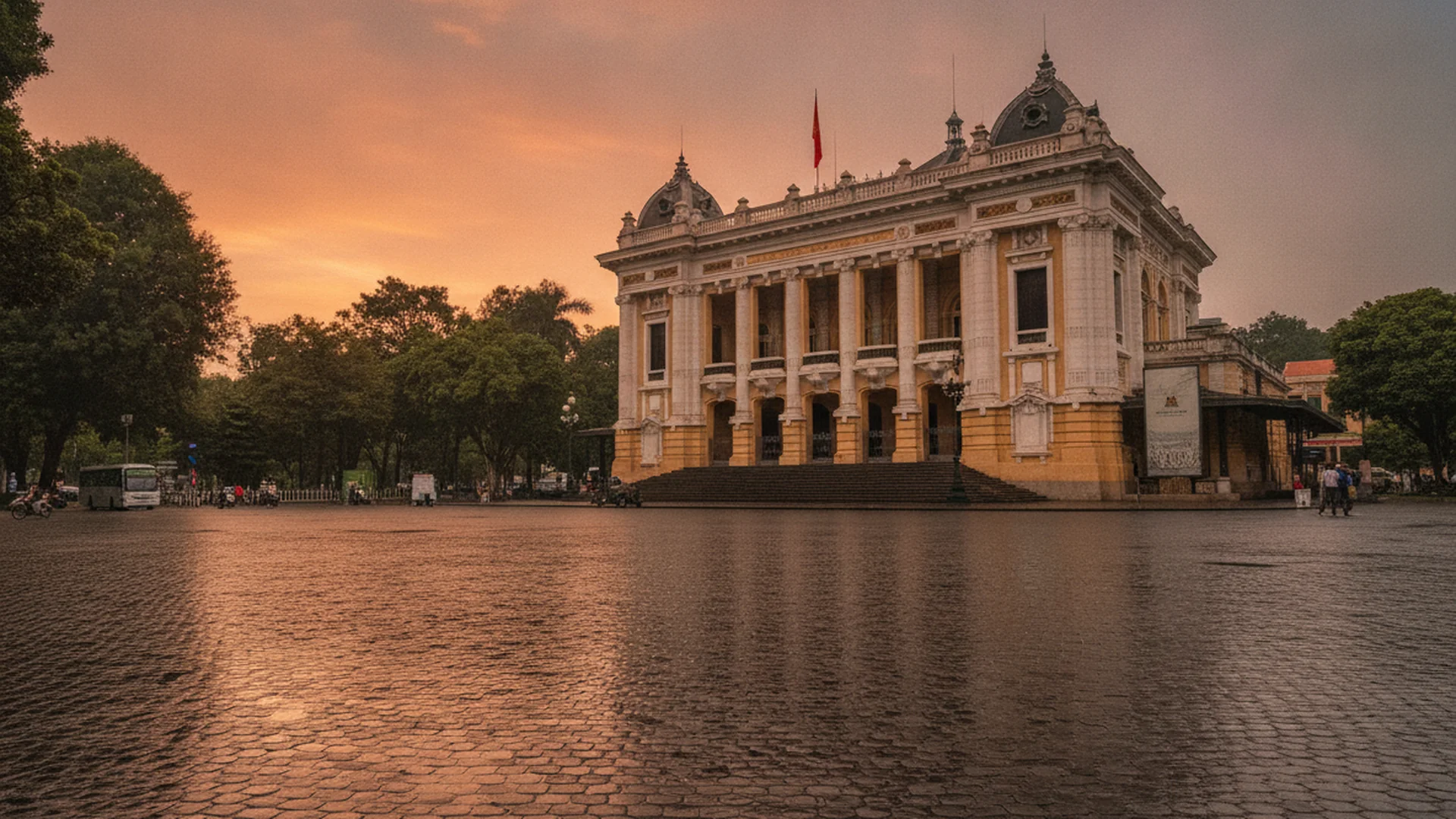
Walk a 2.5 km loop (60-90 min): Hanoi Opera House -> Trang Tien -> Sofitel Metropole -> Ly Thai To Park -> National Museum of History. Go 09:00-11:00 or after 16:00. Courtyards: ask security, stay quiet, no flash; buy a drink if it's a cafe. Tea 14:30-17:30; shows ~20:00.
Why this guide
About this guide
The French Quarter began taking shape from the 1880s onward, when colonial administrators carved out a modern administrative district southeast of Hoan Kiem Lake. Wide boulevards, geometric city planning, and grand colonial buildings replaced traditional Vietnamese structures, producing an urban fabric deliberately unlike the Old Quarter's narrow tube-house streets. Three decades of construction left a district whose architecture, street layout, and public institutions still define central Hanoi today.
Two of the quarter's most visited buildings anchor opposite ends of its history. The Hanoi Opera House at 1 Trang Tien Street, designed by architects Broyer and V. Harley and constructed between 1901 and 1911, stands 34 metres tall over 2,600 square metres, seats 598, and was modelled on the Palais Garnier in Paris. On 3 May 1945 it hosted the first meeting of Vietnam's National Assembly. St. Joseph's Cathedral at 40 Nha Chung Street predates it considerably — the oldest church in Hanoi and the first French colonial construction in Indochina, its neo-Gothic design draws on Notre-Dame de Paris and features two 31.5-metre bell towers, pointed arches, and stained-glass windows. Hoa Lo Prison, built in 1896, completes the colonial timeline: originally a detention facility for Vietnamese political prisoners, it later held U.S. pilots during the Vietnam War — acquiring the nickname 'Hanoi Hilton' — and now operates as a museum with exhibits including a French guillotine, POW personal artifacts, and displays on the independence struggle.
The quarter's institutional buildings extend the Indo-French architectural record. The National Museum of Vietnamese History on Trang Tien Street occupies the former Louis Finot Museum, built in 1932 with a façade that fuses Indochinese and European elements. Nearby, the State Bank of Vietnam on Ly Thai To Street, dating from 1930, presents large columns and high domes in a neoclassical register. Beyond these public monuments, the quarter's residential fabric rewards closer attention: colonial villas — many now serving as embassies or NGO offices — conceal garden courtyards behind ornate iron gates, while tree-lined streets including Trang Tien, Phan Chu Trinh, and Ly Thuong Kiet carry mosaic-tile façades, wrought-iron balconies, and café terraces that remain accessible at walking pace.
Key facts & good to know
Where is the French Quarter and how does it differ from the Old Quarter?
The French Quarter occupies the blocks southeast of Hoan Kiem Lake, bounded roughly by Trang Tien, Ngo Quyen, Hai Ba Trung, and Ly Thai To streets. Its grid layout, 15-metre pavements, and lower traffic density contrast sharply with the Old Quarter's narrow tube-house lanes.
From the 1880s onward, colonial administrators carved out a modern administrative district southeast of Hoan Kiem Lake, replacing traditional Vietnamese structures with wide boulevards, geometric street grids, and grand institutional buildings. The result is a district whose street widths and building setbacks bear no resemblance to the Old Quarter's dense, interlocking alleyways. Key orientating streets are Trang Tien running east from the lake shore, Ngo Quyen parallel to it one block south, Hai Ba Trung as the eastern boundary, and Ly Thai To skirting the lake's southeastern edge.
The practical difference for a visitor on foot is significant. French Quarter pavements average 15 metres wide in places, allowing comfortable walking even during peak hours, whereas Old Quarter lanes can narrow to under four metres with motorcycles using the full width. Noise levels in the French Quarter are noticeably lower outside the immediate Hoan Kiem waterfront. Accommodation in the French Quarter skews toward full-service hotels and restored colonial properties, while the Old Quarter concentrates budget guesthouses and boutique hostels. The northeastern corner of the French Quarter is roughly 200 metres from the lake's eastern shore — a flat, five-minute walk from the Huc Bridge area.
French Quarter vs. Old Quarter: Key Comparisons
| Metric | French Quarter | Old Quarter |
|---|---|---|
| Primary streets | Trang Tien, Ngo Quyen, Hai Ba Trung, Ly Thai To | Hang Dao, Hang Ngang, Hang Bac, Ma May |
| Typical pavement width | Up to 15 metres | 2–4 metres |
| Street grid | Geometric/regular | Irregular, medieval pattern |
| Distance from Hoan Kiem Lake | 200–500 m southeast | Immediately north and northwest |
| Dominant accommodation type | Full-service hotels, colonial properties | Budget guesthouses, boutique hostels |
| Relative traffic density | Moderate on main boulevards | High — motorcycles dominate alleys |
| Typical noise level (evening) | Low to moderate | High (bars, street trade until late) |
Distances are approximate pedestrian measurements from the Huc Bridge approach on the lake's eastern shore.
Plan a Hanoi trip
Where to stay, when to go, and how to combine the highlights of Hanoi into a paced stopover.
How long does it take to walk the primary colonial route?
The main loop covers approximately 3 kilometres and takes 3–4 hours at a sightseeing pace. The route runs from the Opera House along Trang Tien to the Museum of History, then southwest past the Government Guest House to Hoa Lo Prison, returning via Hai Ba Trung.
A logical sequence starts at the Hanoi Opera House at 1 Trang Tien Street, where the 1901–1911 building — 34 metres tall across 2,600 square metres — anchors the district's northeastern corner. Walking west along Trang Tien brings you past the National Museum of Vietnamese History, housed in the former Louis Finot Museum building of 1932. Continue south on Ngo Quyen past the Sofitel Legend Metropole, then turn southwest along Ly Thuong Kiet toward the Government Guest House before heading north on Hoa Lo Street to the prison museum. The return leg east along Hai Ba Trung closes the loop back to Trang Tien.
Terrain throughout is flat with no significant elevation changes. However, sections of Trang Tien and Ly Thuong Kiet have pavements partially obstructed by parked motorcycles and vendor carts, requiring brief sections of street walking alongside slow-moving traffic. Travelers with mobility limitations should note that cyclos — three-wheeled cycle rickshaws — are available for hire along Dinh Tien Hoang and near the Opera House forecourt and can navigate most of this loop, allowing passengers to observe façades without walking. The full uninterrupted loop without entry stops takes roughly 45 minutes; add 60–90 minutes for each museum visit.
What are the opening hours and entry fees for the historical landmarks?
The Vietnam National Museum of History charges VND 40,000 and closes Mondays. Hoa Lo Prison charges VND 30,000 with an optional VND 100,000 audio guide. The Metropole's bunker tour is restricted to hotel guests only.
The Vietnam National Museum of Vietnamese History on Trang Tien Street (the former Louis Finot Museum, built 1932) is open Tuesday through Sunday; the Monday closure applies regardless of public holidays. Standard adult admission is VND 40,000. Group ticketing counters are located inside the main entrance gate; 45-seater coaches can drop passengers on Trang Tien Street in front of the gate, and vehicles can wait in the side street running along the museum's northern fence, though this is informal and subject to traffic warden discretion during peak hours.
Hoa Lo Prison at 1 Hoa Lo Street, built by the French in 1896, charges VND 30,000 for general admission. An audio guide is available separately for VND 100,000 and covers both the colonial-era Vietnamese prisoner exhibits and the later U.S. pilot detainee section. Coach drop-off operates on Hoa Lo Street directly outside the entrance; coaches should not wait on Hoa Lo itself but can use the broader Hai Ba Trung junction 80 metres east. The Sofitel Legend Metropole's 'Path of History' bunker tour — covering the air-raid shelter used during the American War — is accessible only to hotel guests and is not available as a standalone ticketed attraction for day visitors or tour groups.
French Quarter Landmark Entry Data
| Site | Admission (adult) | Audio Guide | Closed | Coach Drop-off Point |
|---|---|---|---|---|
| Vietnam National Museum of Vietnamese History, Trang Tien St | VND 40,000 | Not specified | Mondays | Trang Tien St, main gate; vehicles wait on northern side street |
| Hoa Lo Prison Museum, 1 Hoa Lo St | VND 30,000 | VND 100,000 | No regular closure stated | Hoa Lo St outside entrance; coaches to Hai Ba Trung junction to wait |
| Sofitel Metropole bunker (Path of History) | Hotel guests only | N/A | N/A — restricted access | Ngo Quyen St hotel entrance |
| Hanoi Opera House exterior, 1 Trang Tien St | Free (exterior) | N/A | N/A | Trang Tien St forecourt — short drop-off only |
All prices are in Vietnamese Dong (VND). Confirm current hours directly with each venue before scheduling group visits, as operational days can shift around national holidays.
Where are the accessible courtyards and heritage cafes located?
Courtyard cafes and café terraces accessible to the public concentrate in alleys off Trang Tien, Phan Chu Trinh, and Ly Thuong Kiet. Local coffee costs VND 40,000–60,000; high tea settings run VND 600,000 or above.
The French Quarter's interior character is less visible from its main boulevards than from the narrow passages and short alleys that connect them. Streets such as Trang Tien, Phan Chu Trinh, and Ly Thuong Kiet have retained café terraces behind wrought-iron balconies and in small forecourt gardens of former villas. These are the accessible public-facing spaces: ground-floor cafes and restaurants operating in buildings whose courtyard gardens are partially visible from pavement seating. A standard Vietnamese coffee — ca phe sua da or an espresso at a heritage-style café — typically runs VND 40,000–60,000. High tea service, most notably at the Sofitel Legend Metropole, is priced at VND 600,000 and above per person.
A practical distinction matters for planning: many colonial villas in the French Quarter are now embassies, NGO offices, or government residences. These properties conceal garden courtyards behind ornate iron gates but are not publicly accessible — security staff enforce perimeter restrictions, and photographing certain embassy compounds from the street can draw attention. Residential blocks on streets such as Ngo Quyen similarly contain private courtyards that are not open to casual visitors. The accessible café and courtyard experiences are concentrated in the commercial sections of Trang Tien, the short alleys feeding off Phan Chu Trinh, and the northern end of Ly Thuong Kiet, where retail and hospitality businesses occupy villa ground floors.
What transportation logistics and pedestrian hazards apply to this district?
Vehicle access to Trang Tien Street is restricted Friday 19:00 to Sunday 24:00 as part of the Hoan Kiem pedestrian zone. Cyclo hire runs VND 150,000–200,000 per hour. Crossing multi-lane boulevards without pedestrian signals requires specific technique.
The pedestrian zone centred on Hoan Kiem Lake expands on weekends to include Trang Tien Street, with vehicle restrictions in effect from Friday at 19:00 through to Sunday at 24:00. During these hours, coaches and private vehicles cannot proceed along Trang Tien and must reroute via Hai Ba Trung or Ly Thai To to access drop-off points near the Opera House or the museum. DMC and tour operators scheduling group arrivals on weekend evenings should build in additional transfer time and confirm alternative drop-off coordinates in advance. Cyclos are available near Dinh Tien Hoang Street and around the Opera House forecourt at a standard rate of VND 150,000–200,000 per hour; negotiate and agree the full route before departure, as drivers sometimes request supplements for longer circuits.
The French Quarter's four-lane boulevards — Hai Ba Trung in particular — operate without pedestrian crossing signals at many intersections, which is the standard condition across central Hanoi. The established crossing method is to step off the kerb at a pace that allows oncoming motorcycles to read your trajectory and adjust around you: move steadily and at constant speed, avoid sudden stops or reversals, and make eye contact with approaching drivers where possible. Do not wait for a complete gap in traffic — it will not come at peak hours. Elderly travelers, children, and anyone with impaired mobility should cross only at signalised junctions or use a local guide or hotel staff member to assist. The pedestrian weekend zone around Hoan Kiem eliminates this hazard on Trang Tien for the Friday-to-Sunday window, making that the lower-risk period for walking the central part of the route.
Multi-lane roads in the French Quarter, including Hai Ba Trung and Phan Chu Trinh, have no pedestrian crossing signals at most junctions. Travelers must cross by entering traffic flow at a steady, predictable pace — do not stop mid-crossing. Arrange assisted crossings for elderly or mobility-impaired clients. Vehicle access to Trang Tien Street is suspended Friday 19:00 to Sunday 24:00; coaches attempting entry during this window will be turned back by traffic marshals. Confirm alternative drop-off routing (Hai Ba Trung or Ly Thai To) with drivers before weekend departures.
Hanoi attractions & tickets
Pre-purchased entrance tickets, private transfers and certified guides — no queues, no logistics hassle.
Building a hanoi itinerary for your clients?
Send us your dates and pace — we return a realistic, booked-and-paced plan with net rates, not a generic template.
Want this tailored to your dates?
We run these routes ourselves. Send your dates, group size and pace and our Hanoi team will build a custom version — with real prices, not estimates.
Frequently asked questions
People also ask
Verified sources
- ATL DMC booking log · 12,000+ trips since 2011
- Hanoi Department of Culture & Sport — Opera House Heritage Through Light and Technology · https://sovhtt.hanoi.gov.vn/en/hanoi-opera-house-heritage-speaking-through-light-and-technology/
- Vietnam Tourism Information — Hanoi Opera House · https://www.vietnamtourism.org.vn/travel-guide/destination-in-vietnam/hanoi-opera-house-truly-a-beautiful-building-in-hanoi.html
- Wikipedia — Hanoi Opera House · https://en.wikipedia.org/wiki/Hanoi_Opera_House
Turn this guide into a trip
The products we actually run for this route — book direct, no OTA markup.
Plan your custom trip with Phuong Le
Phuong Le
“Tell us your dates and pace — we'll turn this guide into a realistic, booked-and-paced trip for you, not a generic template.”
Plan my trip with our team →About the authors
Phuong Le · primary author
Specialty: Hanoi · Halong Bay · Vietnam itineraries.
Cross-category lattice
Plan your trip
Practical
Related travel guides
1× per month · pillar guides + new itineraries
Get our newest pillar guides + quarterly itinerary updates delivered. No spam, no promotions, just travel-guide content. Unsubscribe anytime.